
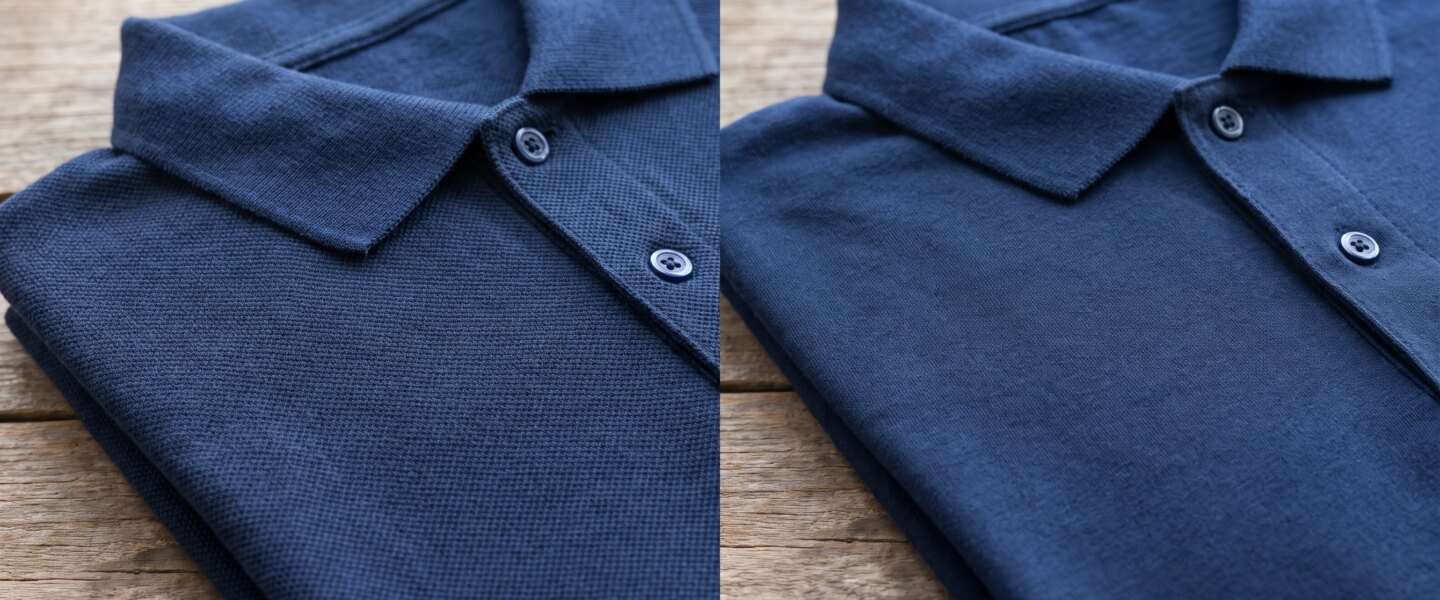
Embroider piqué, print jersey. That rule holds for nine polo shirt jobs in ten: the raised waffle of a piqué knit gives a stitched logo something to settle into, while a DTF transfer pressed over the same surface shows every cell through the film. Below is what the two knits are, the weights that matter, five real models with codes, and what a four-logo polo costs from our Forest Gate studio in September 2026.
What piqué and jersey actually are
Both are knits, not wovens, and both are usually cotton. The difference is in the stitch.
Jersey is the plain single knit of every t-shirt you own: each needle loops the same way, so the face is smooth and flat and the back shows the purl side. A jersey polo is a t-shirt body with a collar and a placket added, and it behaves like a t-shirt on the press.
Piqué (pronounced pee-kay) uses tuck stitches. Some needles hold a loop for a course or two before knitting it off, and that pulls the fabric into rows of small raised cells: a honeycomb, or a waffle on a coarser knit. Run a thumb across it and you feel the bumps. Hold it to a window and you can see light through the cells, which is why piqué breathes better than jersey of the same weight and why it was a tennis fabric long before it was a workwear one.
Two knock-on effects decide which decoration goes on which polo. Piqué is more stable across its width (the tuck structure resists stretch) and it's thicker for its weight, so it hides a needle well and shows a flat film badly. Jersey stretches more, lies flat, and takes a transfer the way a tee does. That's the whole argument in two sentences. The rest is detail and model codes.
Why embroidery sits well on piqué
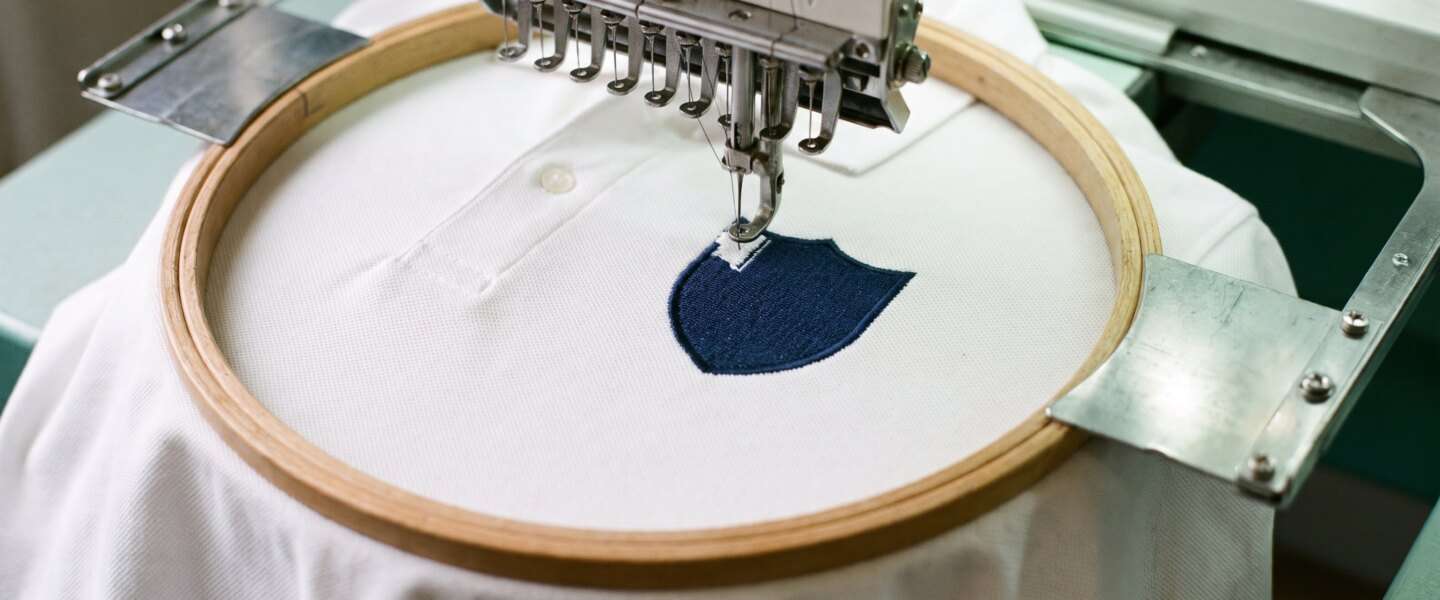
A left-chest logo about 80 mm wide runs to 5,000 to 8,000 stitches, and each one is a needle punching through the cloth and pulling thread tight behind it. The fabric under that has to hold still. Piqué's tuck structure gives it body: the cells compress under the presser foot and spring back around the finished stitching, so the logo settles down into the surface rather than sitting on top of it. Satin-stitch lettering keeps its edges. Fine outlines don't wander.
Jersey can be embroidered, but it needs a cutaway backing (a stiff non-woven stabiliser that stays in the garment) to stop the stretch, and on a 180 gsm jersey a dense fill over about 8,000 stitches still pulls the fabric into ripples around it. The same design on a 170 gsm piqué lies flat. Cap height is the other limit: stitched lettering under 5 mm loses the holes in its e's and a's on any knit, so a logo with a strapline needs the strapline dropped or the whole logo scaled up.
Our embroidery is priced by stitch count, with a one-off £20 digitising charge per logo that's often waived on orders over £500. Digitising is the conversion of your artwork into a stitch file, and it's done once: the same file runs on every polo you order after, in any thread colour. An embroidered polo also washes hotter than a printed one, which matters if the polos are going through a kitchen laundry every night.
Why DTF sits better on jersey, and what piqué does to a transfer
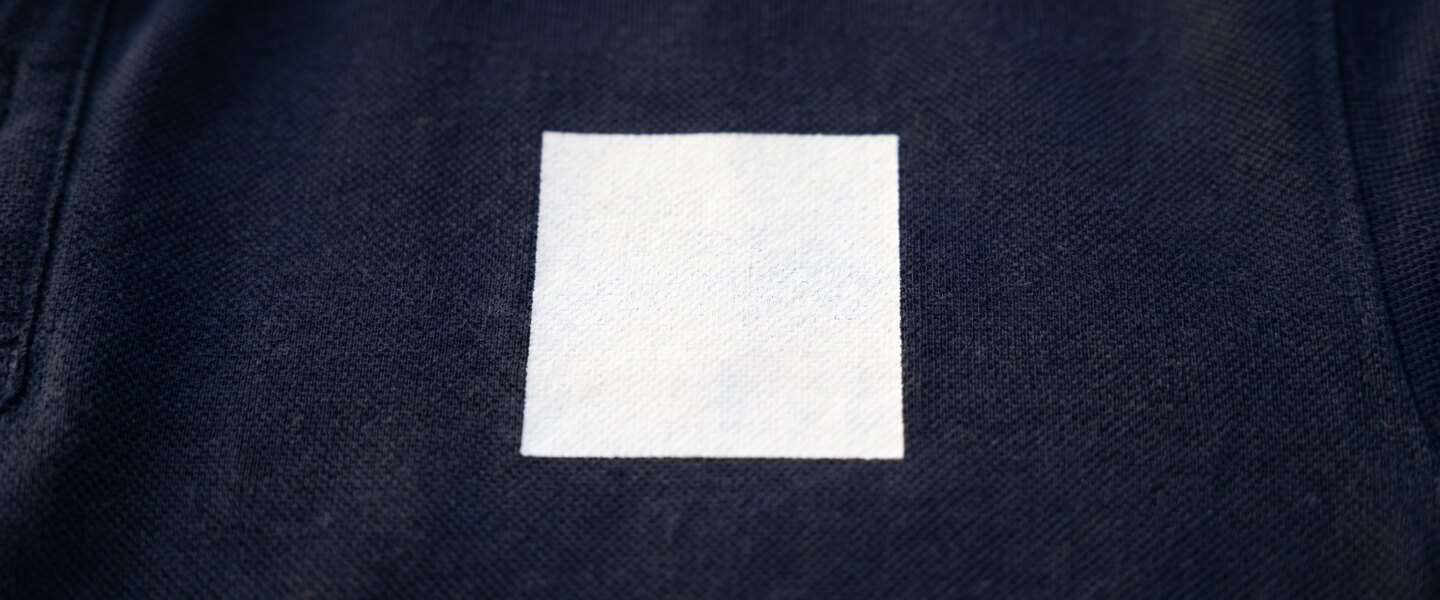
A DTF transfer is a printed film with a layer of hot-melt adhesive powder on the back. Under the press the adhesive softens and flows onto whatever is beneath it, and the film copies that surface exactly. On flat jersey the copy is a flat print. On piqué the film drapes over every cell, and once it cools the print carries the honeycomb with it: a solid block of colour looks dimpled, hairlines break where they cross a cell wall, and text under about 6 mm goes lumpy. It doesn't peel and it doesn't crack. It just doesn't look like your artwork.
The effect is worse on heavier piqué, because 200 gsm cells are deeper than 170 gsm ones, and worse on white and pastel polos, where the shadow in each cell shows through a light print. A white print on a navy piqué hides it best.
If the job has to be a printed piqué, three things help, in order of how much:
- Switch the garment to a jersey polo. The Kariban K241 below exists for exactly this.
- Failing that, take the fine detail out: solid shapes, no hairlines, lettering at 8 mm or more, and pick the lightest piqué on the list.
- Press it properly. Our recipe is a 2-second pre-press at 150°C to drive out moisture, 12 seconds under the platen, peel after 3 seconds, then a 3-second re-press. Polyester goes on at 135°C. The full set is on our heat press settings page.
Prints are priced per panel, so a left-chest print and a back print are two panels. Jersey takes a full-colour transfer, a photo, a gradient sponsor logo or a 3 mm hairline without complaint, and that is the case for it.
Weights and five models worth knowing
Polo weights run from about 160 gsm (a light summer jersey) to 240 gsm (a heavy winter piqué). For a printed or embroidered polo the useful band is 170 to 200 gsm: light enough to wear all day indoors, heavy enough that the collar keeps its shape past the tenth wash. Five models with codes you can put straight on a quote:
| Model | Knit | Fabric | Weight | Decorate with |
|---|---|---|---|---|
| SOL'S Summer II 11342 | Piqué | 100% ringspun combed cotton | 170 gsm | Embroidery; a bold print at a push |
| SOL'S Prime 00571 | Piqué | 65% polyester, 35% cotton | 200 gsm | Embroidery |
| Gildan 64800 Softstyle | Double piqué | 100% ringspun cotton (heathers blended) | 177 gsm | Embroidery; a bold print |
| Russell 569M Classic | Piqué | 100% ringspun combed cotton | 200 gsm | Embroidery |
| Kariban K241 | Jersey | 100% combed ringspun cotton | 180 gsm | DTF print; embroidery with backing |
SOL'S Summer II 11342. The budget piqué, and the one with the shallowest cells, which is why it takes a bold print better than the 200 gsm polos do. SOL'S list it at 170 gsm in 100% ringspun combed cotton on the Summer II spec page (2026 catalogue), with a rib collar, a three-button placket and a long colour list.
SOL'S Prime 00571. Same brand, different job. It's a 65/35 polyester-cotton piqué at 200 gsm, so it holds its colour through hot washes, dries fast and creases less than pure cotton. That's the hospitality and trades polo. Embroider it. If you must print it, treat it as polyester: 135°C, not 150°C, and the dye migration guide explains the press marks you're avoiding.
Gildan 64800 Softstyle. A double piqué, which means the tuck pattern is knitted on both faces and the cells are smaller and tighter than a classic single piqué. It's the softest of the four piqués here, 177 gsm in ringspun cotton (Sport Grey and the other heathers carry a polyester share), and the small cells show through a print less than a classic piqué's do. Gildan's own spec sheet on gildan.com (2026) has the current colour list.
Russell 569M Classic Cotton Piqué. The corporate polo: 200 gsm of 100% ringspun combed cotton with a collar that keeps its shape. Russell Europe publish the spec at russelleurope.com (2026 range). It has the deepest cells on this list, so don't print it; a stitched left-chest logo is what it's for.
Kariban K241. The one jersey on the list: 180 gsm 100% combed ringspun cotton, a flat single knit with a polo collar and placket, listed on kariban.com (2026 catalogue). This is the polo to print. It takes a DTF transfer like a heavy tee, and it can be embroidered with a backing if the design is a light one.
Which polo for which job
Office and front of house. Russell 569M or the Gildan 64800 with an embroidered left-chest logo, 70 to 90 mm wide. Cotton piqué is the right call for people sat at desks: it breathes, and a stitched logo on a 200 gsm collar polo reads as uniform without reading as overalls. The corporate apparel page covers the matching quarter-zips and jackets.
Kitchens, cleaners, trades. SOL'S Prime 00571, embroidered. The polyester share is what survives the 60°C laundry and the bleach splash, and stitching survives it with the fabric. Our hospitality uniforms page has the apron and polo sets priced together.
Sports clubs with sponsors. Split the crest from the sponsors. A crest is a stitch job. Sponsor logos with gradients, photos or tiny web addresses are print jobs, so a club polo with four sponsor logos usually lands one of two ways: a printed K241 with all four transferred, or a piqué with the crest stitched and one bold sponsor stitched under it. Names are £2.50 each on top.
Events and one-day jobs. K241, printed. If the artwork is approved by 1pm it's ready to collect from 4.30pm through our same-day service, and 200 garments have gone through on that notice.
Your own polos. You can bring your own garments for £1 handling each, at your risk, and we ask for two spares on a run of 20 because a piqué that's been through a wash already will press differently from a new one.
What a polo costs in September 2026
Worked from our price list this month, with no VAT added because we're not yet VAT registered:
- A polo with four logos (a crest plus three sponsors, or a company logo front and back with two more): £18 to £25 each, the spread depending on how many of the four are stitched and how many stitches they take.
- Digitising: £20 once per logo, often waived on orders over £500.
- Names: £2.50 each.
- Delivery: £15 per address on business orders, or collect from the unit at Sherrard Works, Forest Gate, E7 8DN.
There's no minimum order, so one polo is fine, but every order is paid before production because a polo with your logo on it can't be resold. Blanks from SOL'S, Gildan, Russell and Kariban arrive next day if the order is paid before 4.30pm.
Every job gets a free artwork check, and if your logo only exists as a fuzzy JPEG our in-house designers redraw it before it's digitised or printed. What we won't do is copy a registered brand's mark onto a polo, however good the crocodile looks on the mock-up; the artwork policy has the detail. Send the job through the quote form with the model code, the quantity and the logo positions, and it comes back priced.
Washing, lint and where the logo goes
Printed polos wash below 30°C, inside out. Embroidered ones can go hotter, which is the second reason kitchens get stitched Primes rather than printed ones. Most cotton polo care labels say 40°C; where a print is involved, the print's limit wins. Our 50-wash test on Gildan Softstyle tees showed no failure, and the same film and adhesive go on a polo.
When a transfer does lift it's nearly always one of two things: moisture in the fabric because nobody pre-pressed it, or dust and lint on the surface. Piqué is worse for the second. The cells hold fluff from the bag and the box, so a lint roller across the print area before the pre-press is part of the job, not an extra.
Placement is the last trap. A logo centred on the chest of a polo lands on the buttons. Left-chest positions sit to the wearer's left of the placket, centred between the placket and the side seam, with the top edge about 75 mm below the shoulder seam. On a piqué with a stitched logo, ask for the hoop to clear the placket by at least 20 mm, or the needle catches the button facing and the collar pulls to one side.