
Ask the trade what gsm is a heavyweight t shirt and the usual answer is about 200 gsm and above, with most blanks sold as heavyweight sitting between 200 and 240 gsm. No law or standard defines the word, so one maker's heavy is another's mid weight. Below: what gsm measures, the ounce conversion, real blanks at 150, 180, 200 and 240 gsm, and what the weight changes for a DTF transfer, a stitched logo, postage and shrinkage.
What gsm is a heavyweight t-shirt?
About 200 gsm and up. That is trade habit, not a rule. No British or international standard sets a weight at which a t-shirt becomes heavyweight, and nothing in UK labelling law makes a seller prove the word.
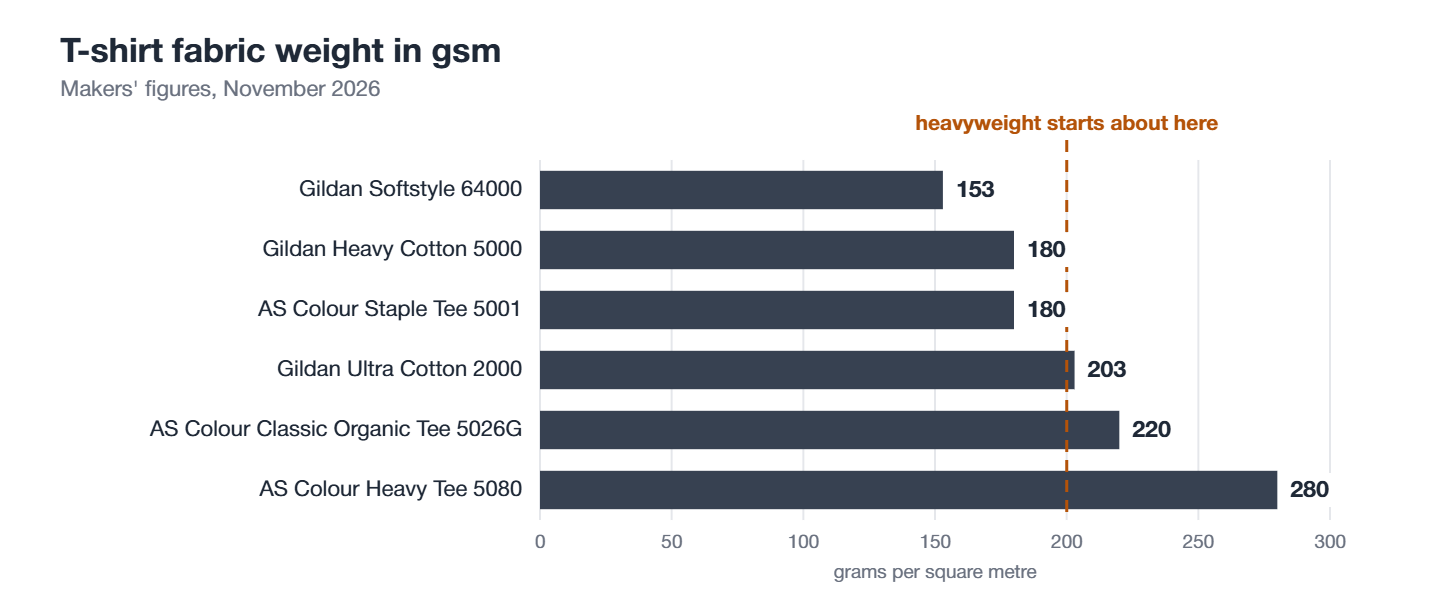
The makers show how loose it is. AS Colour's European range page (November 2026) labels its 180 gsm and 200 gsm tees mid weight and starts heavy weight at 220 gsm. Gildan sells a 180 gsm tee under the name Heavy Cotton and a 203 gsm tee as Ultra Cotton. Ask for the number.
As a working scale for cotton t-shirts:
- Around 150 gsm: lightweight. The thin, soft retail feel.
- Around 180 gsm: midweight, and the weight most printed tees in Britain are made at.
- 200 to 220 gsm: where heavyweight starts for most of the trade.
- 240 gsm and over: heavyweight by anyone's measure, the dense streetwear tee that holds its shape on the hanger.
One thing to clear up early: heavyweight is a weight and not a fit. A boxy or oversized tee can be cut from 150 gsm jersey, and a 240 gsm tee can be a regular fit.
What gsm measures, and how to convert ounces to gsm
GSM is grams per square metre: the mass of one square metre of the fabric, laid flat. A size S and a size 3XL in the same tee share the same gsm.
The lab method is BS EN 12127:1998, which BSI lists as current in November 2026. It sets out how to find mass per unit area from small samples of woven or knitted fabric, weighed in a standard atmosphere, oven dry, or both. The older ISO 3801:1977, last confirmed by ISO in 2023, does the same job but its scope is woven fabrics, so for a knitted jersey the EN is the one that applies.
American blanks are specified in ounces per square yard. One ounce is 28.3495 g and one square yard is 0.836127 square metres, so 1 oz/yd² is 33.906 gsm. Multiply ounces by 33.906:
| oz/yd² | Sum | gsm (rounded) |
|---|---|---|
| 4.5 | 4.5 x 33.906 = 152.6 | 153 |
| 5.3 | 5.3 x 33.906 = 179.7 | 180 |
| 6 | 6 x 33.906 = 203.4 | 203 |
| 6.5 | 6.5 x 33.906 = 220.4 | 220 |
| 7.5 | 7.5 x 33.906 = 254.3 | 254 |
Odd figures such as 153 and 203 gsm on a spec sheet are round ounce weights, 4.5 and 6, converted to metric.
Why gsm alone does not tell you thickness or quality
Two tees at 180 gsm can feel nothing alike. Weight says how much fibre is in a square metre and nothing about how it was spun or knitted.
Yarn type
Ring-spun yarn is twisted so the fibres lie along the thread, which gives a smoother, stronger yarn. Combed cotton has had the short fibres removed before spinning, so the surface is cleaner still. Open-end yarn is quicker to make and comes out bulkier and a little hairier, so the fabric feels thicker and drier in the hand for the same weight.
Yarn count and knit density
Yarn count is the thickness of the single thread. In the English cotton system a higher number is a finer yarn, so 30 singles is thinner than 22 singles. AS Colour specifies its 220 gsm Classic Organic Tee as 22 singles, combed (maker's page, November 2026). A mill can reach the same gsm with a thick yarn knitted loosely or a fine yarn knitted tightly. The tight knit is flatter, denser and less see-through.
Tolerance
A quoted weight is a nominal figure. Gildan's European catalogue (2024 edition) lists Softstyle at 153 gsm in colours and 144 gsm in white, and Ultra Cotton at 203 gsm in colours and 193 gsm in white: same model code, about 10 gsm apart. Dye adds mass, cotton takes on moisture from the air (the standard conditions the sample first for that reason), and batches vary. Treat a 5 to 10 gsm gap between two blanks as no gap.
Real blanks at 150, 180, 200 and 240 gsm
These are maker's specification weights, as of November 2026. The Gildan figures come from Gildan's own European catalogue (2024 edition) and the AS Colour figures from AS Colour's European range and product pages, all checked in November 2026.
| Band | Maker and model | Maker's quoted weight | Maker's notes |
|---|---|---|---|
| Around 150 gsm | Gildan Softstyle (64000) | 153 gsm (white 144 gsm) | Ring spun |
| Around 180 gsm | Gildan Heavy Cotton (5000) | 180 gsm | 100 per cent cotton |
| Around 180 gsm | AS Colour Staple Tee (5001) | 180 gsm | Labelled mid weight, regular fit |
| Around 200 gsm | Gildan Ultra Cotton (2000) | 203 gsm (white 193 gsm) | 100 per cent cotton |
| Around 220 gsm | AS Colour Classic Organic Tee (5026G) | 220 gsm | Labelled heavy weight; 22 singles combed organic cotton; preshrunk |
| 240 gsm and over | AS Colour Heavy Tee (5080) | 280 gsm on the maker's product page | Labelled heavy weight, relaxed fit |
For how these brands compare on cut, colour range and price, see our posts on the best blank t-shirts for printing and the best blank garments for DTF. This page stays with weight.
What fabric weight changes for DTF printing and embroidery
A DTF transfer is a thin film of ink and adhesive pressed onto the face of the fabric. It has its own thickness and stiffness, and the lighter the tee, the more of the garment's feel the print takes over. On 150 gsm jersey a solid A3 block hangs like a panel and the edge of the film reads as a faint ridge when the fabric drapes over it. On 220 or 240 gsm the cloth is stiffer than the film, so the edge all but disappears and the print sits flat.
On a light tee, break a big solid into lettering and open shapes so the fabric can move between them.
Pressing does not change with weight. Our recipe for cotton is the same at 150 gsm and 240 gsm: pre-press at 150°C for 2 seconds to drive out moisture, press for 12 seconds, peel after 3 seconds, re-press for 3 seconds. The pre-press matters more on a heavy tee because a thick cotton jersey has more fibre to hold damp, and moisture is one of the two usual causes of a failed transfer (lint is the other). The full chart is on our heat press settings page.
Embroidery is where weight helps most. Every stitch pulls the fabric in a little, and a thin, stretchy jersey gives way: the cloth gathers around the logo and puckers. A heavier, denser jersey resists that pull, so a left-chest logo sits flatter with less backing behind it. A light tee can still be stitched: keep the logo small and open, and skip dense filled crests. Digitising is £20 once per logo and each garment is then priced by stitch count.
Summer, winter and the postage weight of a heavier tee
Less fibre per square metre means less insulation and faster drying, so 150 to 160 gsm is the comfortable weight for July, a fun run or a hot kitchen. From 200 gsm up a tee is warmer, hangs straighter and hides what is under it. For a staff tee worn all year, 180 gsm is the usual middle.
Weight also lands on the postage bill. A size L tee uses roughly 1.1 to 1.3 square metres of fabric once you count the body, sleeves, hems and collar. That area is an estimate, and so are the sums:
- 150 gsm x 1.1 to 1.3 m² = about 165 to 195 g a tee
- 240 gsm x 1.1 to 1.3 m² = about 264 to 312 g a tee
- The difference is 90 gsm x 1.1 to 1.3 m² = about 99 to 117 g, so call it 100 to 120 g more per shirt
On a box of 50 that is 5 to 6 kg of extra cloth before any packaging.
If you post orders yourself, the bands matter. Royal Mail's Small Parcel takes up to 2 kg and 45 x 35 x 16 cm (Royal Mail, November 2026). On the sums above that is about ten 150 gsm tees or six 240 gsm tees before the bag is weighed. Weigh a real packed order before you set your prices.
Does a heavier t-shirt shrink less?
Not as a rule. Shrinkage comes from the fibre and from how the mill finished the fabric, and gsm measures neither.
So look for what the maker states. AS Colour describes its 220 gsm Classic Organic Tee as "preshrunk to minimise shrinkage" and gives the care as a cold machine wash, line dry, no tumble drying (maker's page, November 2026). The word is minimise, so allow for some movement. Where a spec sheet does give a percentage, it should come from a wash test: ISO 5077 is the method for measuring dimensional change after washing and drying, run with the domestic wash procedures in ISO 6330.
We have not published shrinkage figures of our own for these blanks and will not quote someone else's as ours. Our care advice for anything printed is a wash below 30°C, inside out. If the fit is critical, wash one blank the way the wearer will before you commit to a run.
Which weight to order
A giveaway or a one-day event tee is a 150 gsm job. A uniform washed weekly wants 180 gsm. A tee sold at retail prices, or one with a stitched chest logo, earns the step to 200 gsm and over.
As a marker on price, a Gildan Softstyle 64000 with a one-colour front print was £8.50 each at 100 in September 2026, with no VAT added because Brandum is not VAT registered. There is no minimum order, and blanks from the major brands arrive the next day if ordered and paid before 4.30pm. Send the quantity, the weight you want and the artwork through the quote form, and say whether the logo is printed or stitched.