
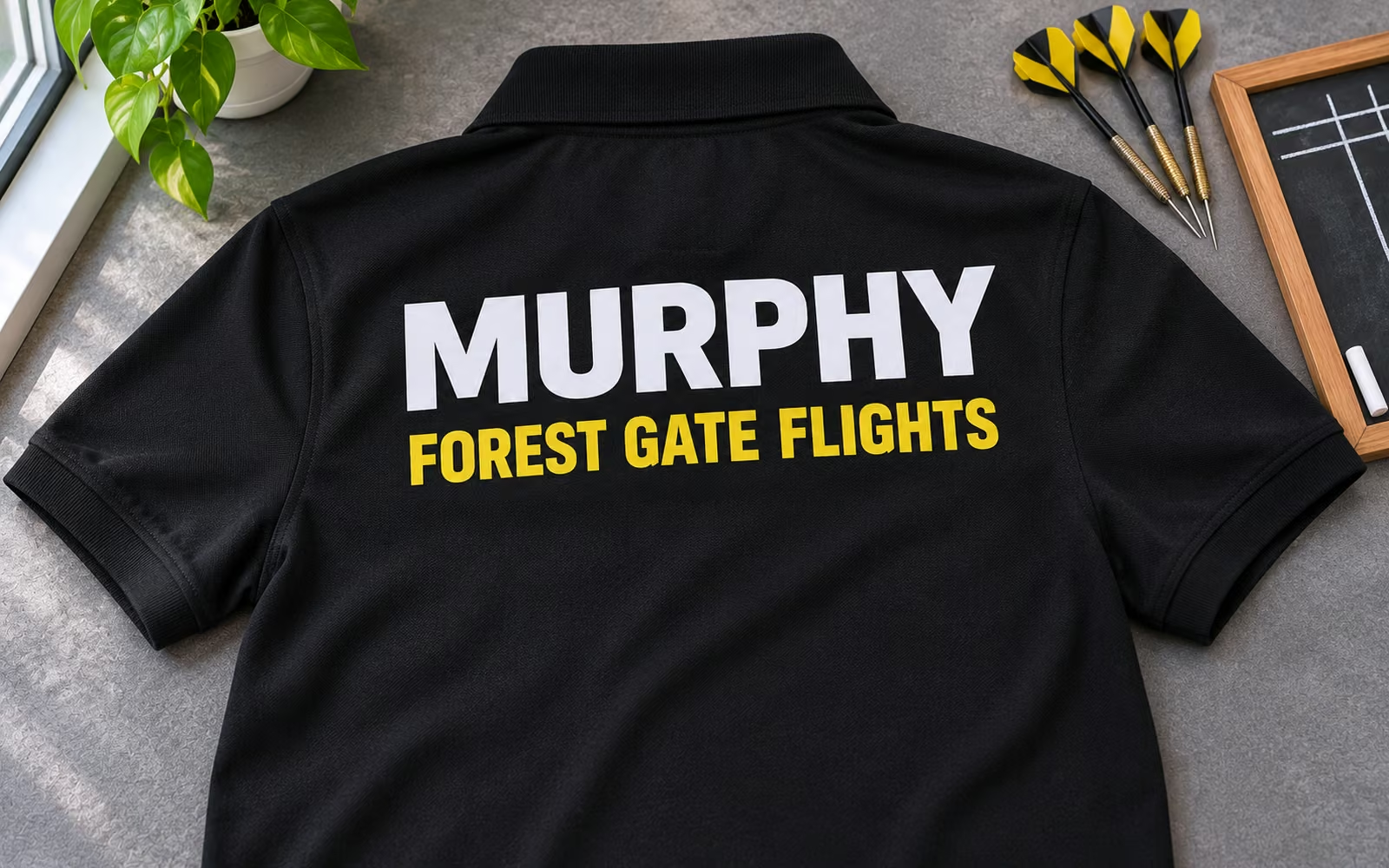
 A pub team of eight in printed piqué polos with a team crest, a sponsor panel, a big back print and a surname on each costs £164 to £220 as of November 2026, with no VAT added. Below: what a darts shirt actually is, four blanks from our shop that take the print, where each element goes and how big, how that price is built, and which names and logos you cannot copy.
What a darts shirt actually is, and what the professionals wear
A darts shirt is a loose polo or crew-neck shirt, in polyester or a cotton piqué, with a bold print across the back and a sponsor panel on the chest. The cut is roomy on purpose. A player raises the throwing arm forty or fifty times a match, and a fitted shirt pulls at the shoulder every time. The shirts the professionals wear at the World Darts Championship, which runs at Alexandra Palace from December into early January, are a different product: sublimated all-over polyester, cut and sewn to the player's own design and covered in sponsor marks. The venue's event page (Alexandra Palace, 2026) has this season's tournament in the Great Hall for the first time. You cannot buy those shirts blank, and we do not stock a darts-cut shirt as such. Sublimation is also a volume process: at Brandum it is only offered from 200 garments, and only on polyester (can you sublimate on cotton explains why). A team of eight, or forty fans on a coach, gets a stock polo or tee in the team colour, a DTF transfer on the back, a crest or sponsor on the chest and a name on each. That shirt is £18 to £25 before names.Which blank takes a big back print and a sponsor panel
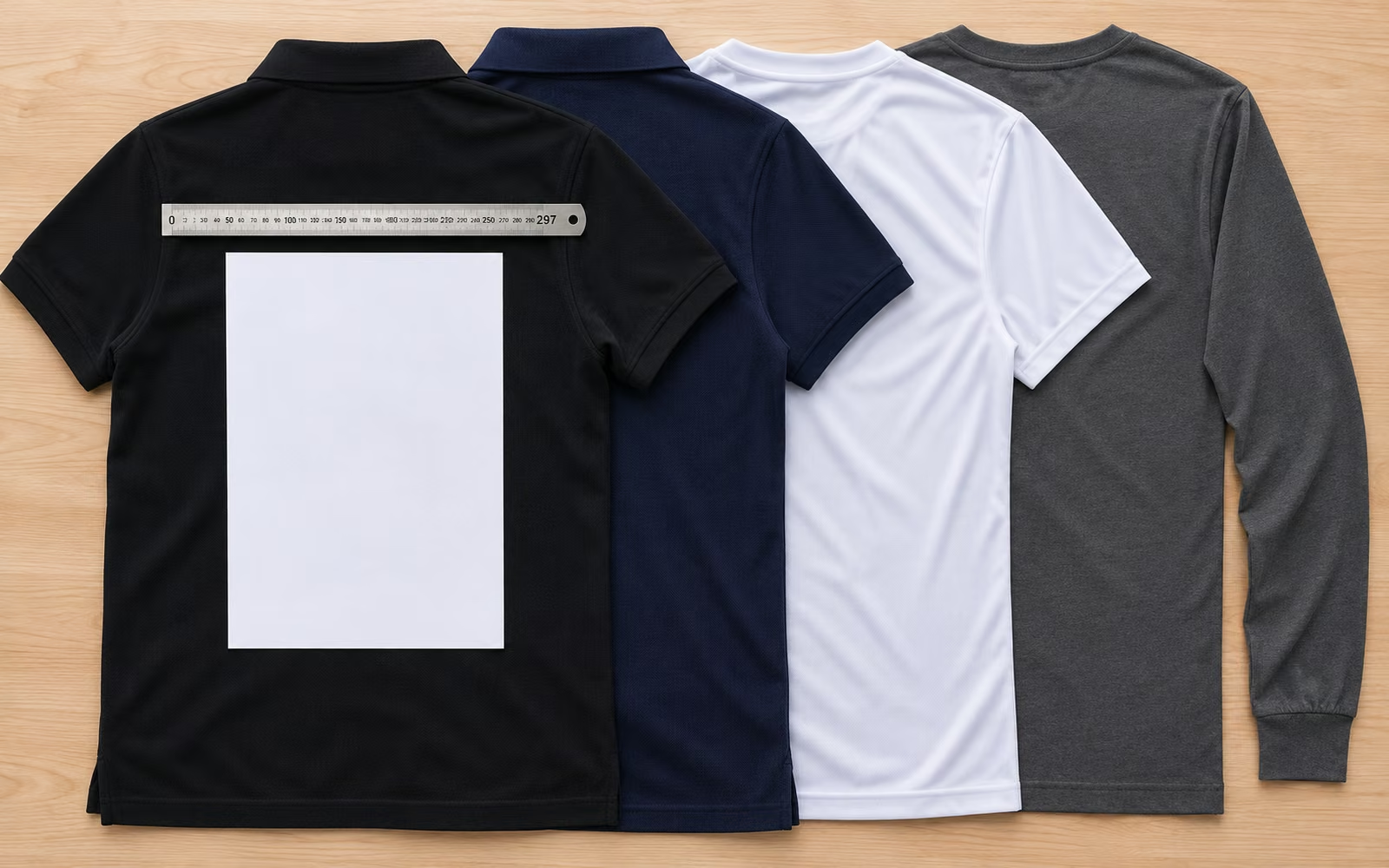
Four blanks from the shop do the job. The weights are the ones listed on each product page as of November 2026.| Shirt | Fabric and weight | Who it suits |
|---|---|---|
| Gildan Softstyle piqué polo 64800 | 100% ring spun cotton double piqué, about 177 gsm | The standard league polo. Softer and lighter than a workwear polo. |
| Fruit of the Loom Premium Polo | 100% cotton piqué, about 180 gsm in colours and 170 gsm in white | Heavier and boxier. Takes an embroidered crest well; the widest colour range of the four. |
| AWDis Cool T JC001 | 100% polyester wicking, 140 gsm | Hot function rooms and summer leagues. Crew neck, no collar. |
| SOL'S Imperial long sleeve 02074 | 100% ring spun cotton, 190 gsm | Winter leagues in cold back rooms. The sleeve takes a small print too. |
 Already own sublimated darts shirts and just need names added? Bring them in. We print on your own garments for £1 handling each, at your risk, which for polyester means 135°C and a test on one shirt first.
Where everything goes, and how big a name has to be
Start with the back, because that is what the room sees. The oche is 2.37 m from the face of the board and the rest of the pub watches from further back, so a surname has to read at 3 to 6 m. A sign-maker's rule of thumb is 25 mm of letter height for every 3 m of viewing distance, which puts a surname at a cap height of 50 to 60 mm in a plain block capital. At 25 mm it reads at arm's length and nowhere else. An A3 panel (297 x 420 mm) is the usual back print: surname across the shoulders, team name or league underneath at half the size. On a size S or a women's cut, keep the artwork under 280 mm wide or it wraps onto the sleeve seam. A team crest goes on the left chest at 80 to 100 mm wide, the sponsor on the right at the same size or across the centre chest at up to 250 mm wide. A sleeve takes a 70 to 90 mm badge. Dark shirt, light print. A DTF transfer carries a white underbase, so white or yellow lettering on a black or navy shirt reads from across the room. Red on black does not. Cotton is pressed at 150°C for 12 seconds after a 2-second pre-press to drive the moisture out, peeled after 3 seconds and re-pressed for 3 seconds. Polyester drops to 135°C, because a red or royal blue polyester shirt pushed to 150°C can bleed dye up through the underbase and turn a white name pink within a week. The fixes are in DTF on polyester sportswear.What a team of eight costs
The price line that fits a darts shirt is the sponsored polo: £18 to £25 each for a polo carrying up to four logos, as of November 2026. A crest on the left chest, a sponsor on the right, a sleeve badge and the back print are four positions. Prints are priced per position, so a back print with one chest panel sits at the bottom of that range and all four sit at the top. Names are £2.50 each on top.| Item | Eight shirts | Sixteen shirts |
|---|---|---|
| Piqué polo with crest, sponsor panel and back print, £18 to £25 each | £144 to £200 | £288 to £400 |
| Surname on each, £2.50 | £20 | £40 |
| Total, no VAT added | £164 to £220 | £328 to £440 |
| UK delivery on a business order, per address | £15 | £15 |
The names and logos you cannot copy
This is where darts orders go wrong. The shirt a fan wants is the one their favourite player walked on in, and that shirt is a stack of other people's property: the design belongs to the player's team and kit maker, the sponsor marks to the sponsors. The PDC and WDF names and logos, the World Championship name and logo, the title sponsor's marks and the broadcasters' graphics are all registered trade marks or protected artwork. The law is section 10 of the Trade Marks Act 1994. Section 10(1) makes it an infringement to use, in the course of trade, a sign identical to a registered mark on the goods it is registered for; section 10(2) extends that to a similar sign where there is a likelihood of confusion. Section 10(4)(a) says a person uses a sign if he "affixes it to goods or the packaging thereof". A printer pressing a logo onto a polo for payment is doing exactly that. Player nicknames are the trap. A nickname can be registered as a trade mark like any brand name, and some of the best-known players' nicknames have been, with clothing among the goods covered. The Intellectual Property Office's guidance on using somebody else's trade mark (gov.uk, 2026) is blunt: to use an existing mark you contact the owner, and you find the owner by searching the register, which is free. A nickname registered for clothing does not go on a shirt without the owner's written licence.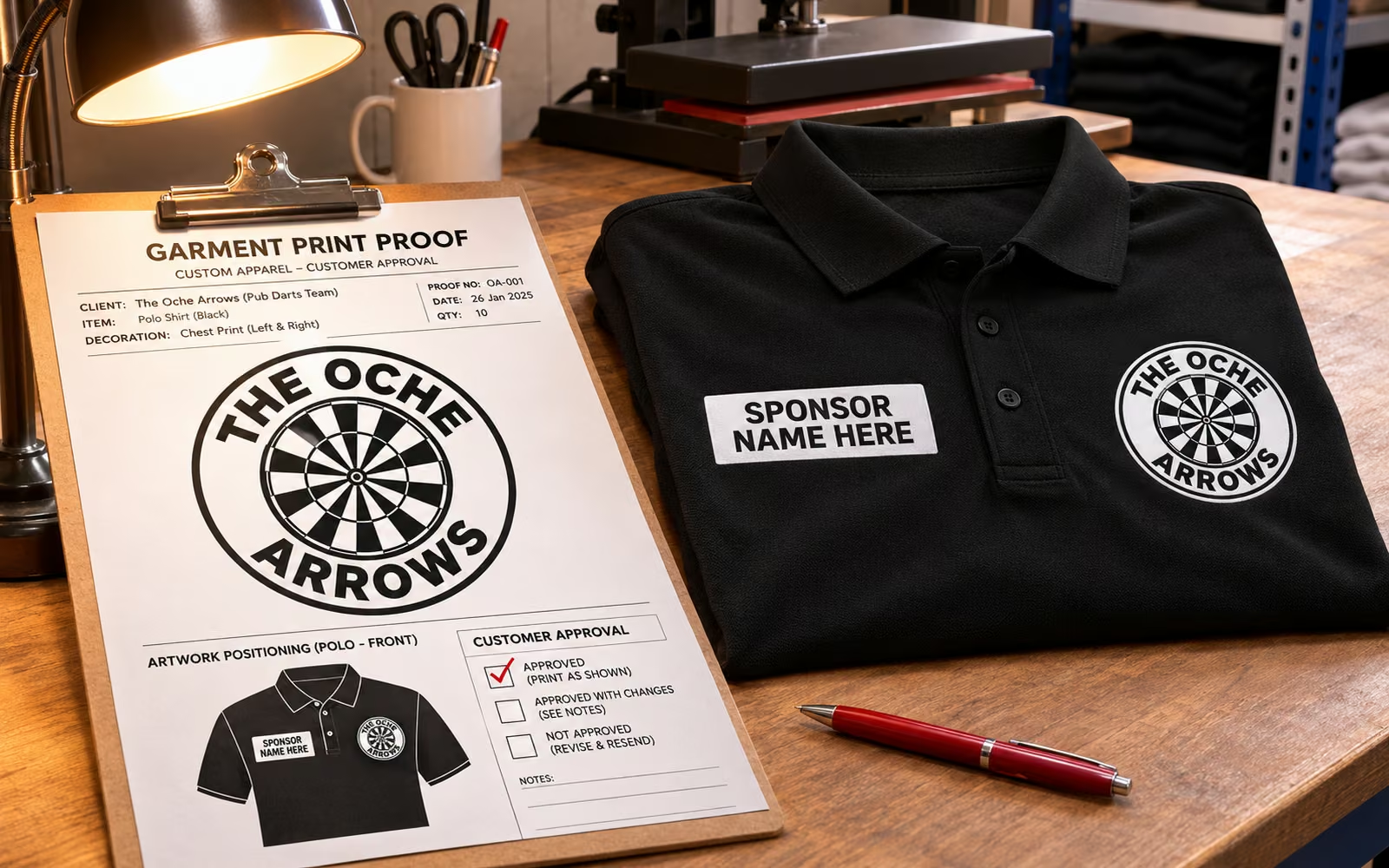 What you can print:
- Your team's own name and your own crest. Our in-house designers redraw a rough sketch or a phone photo of it into clean artwork, and the free artwork check is on every job.
- A nickname you made up for your own player. "The Postman" for the lad who delivers is yours.
- A local sponsor's logo, with their written OK. An email saying "yes, use our logo on the team shirts" is enough from a tyre place or a kebab shop. A brewery, a pub company or any other large brand is only accepted from that company's own email domain with its paperwork, and the brewery logo on your pub sign belongs to the brewery.
- Original slogans, a 180 in big numerals, a dartboard drawing, the pub's name with the landlord's agreement.