
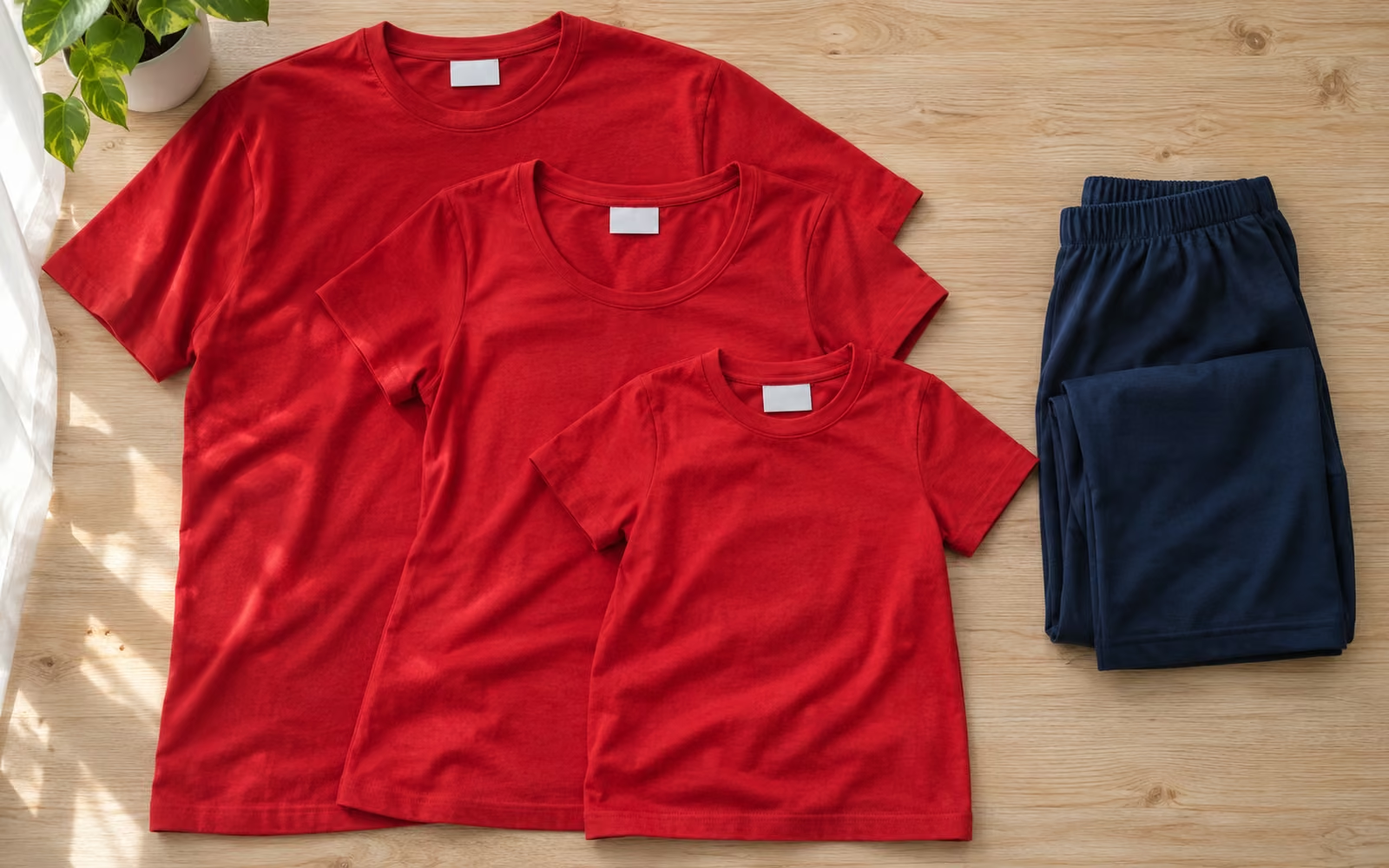
 Yes, you can give or sell personalised pyjamas in the UK, but every pair is nightwear under the Nightwear (Safety) Regulations 1985, so it needs a flammability label in red or black capitals, and a child's nightdress or dressing gown must pass BS 5722 after washing. A print changes none of that, and a printer cannot certify it. Here is the rule, what Brandum will and will not press, and the family tees that print well instead.
What the Nightwear (Safety) Regulations 1985 actually require
The rule is SI 1985/2043, the Nightwear (Safety) Regulations 1985, made on 20 December 1985, in force from 1 March 1987 and still in force as of November 2026. "Nightwear" means nightdresses, pyjamas, dressing gowns, bath robes "and other garments of a like nature and use", including babies' garments. A pyjama set you have printed is nightwear. A t-shirt somebody sleeps in is not, unless you sell it as a sleep shirt. "Children's nightwear" is nightwear designed for and normally worn by someone under 13. Nightdresses also have a size cap of 91 cm chest and 122 cm length; dressing gowns and bath robes have 97 cm chest and a 69 cm sleeve. Pyjamas have no cap. Everything else is "adults' nightwear". A "babies' garment" has a chest of 53 cm or less and is normally worn only under three months. Now the part that surprises people. Regulation 4(1) says children's nightwear must be made of fabric that still meets BS 5722 after washing, with the exception of pyjamas, babies' garments and cotton terry towelling bath robes. Those three skip the burn test. Regulation 4(2) says they must be labelled instead; regulation 6 says the same for adults' nightwear.| Garment | Fabric must pass BS 5722? | Flammability label? |
|---|---|---|
| Child's nightdress (to 91 cm chest, 122 cm long) | Yes, after washing | Not required |
| Child's dressing gown or bath robe (to 97 cm chest, 69 cm sleeve) | Yes, unless cotton terry | Cotton terry only |
| Child's pyjamas, any size | No | Yes |
| Babies' garment (53 cm chest or less) | No | Yes |
| Adult pyjamas, nightdress or gown | No | Yes |
The label: exact words, colour, type size and where it goes
Schedule 2 gives two forms of words and nothing else is acceptable. A garment whose fabric cannot meet BS 5722 after washing must carry KEEP AWAY FROM FIRE in red letters. A garment whose fabric does meet it may carry LOW FLAMMABILITY TO BS 5722 in black, or the red warning, or both. There is no "not tested" option. The lettering is medium upper-case type of 10 point, legible, durable and on a contrasting background, on a label securely attached inside the neck, next to the size label, or on the size label immediately under the size. A swing ticket does not count. If the fabric has been flame-retardant treated, Schedule 3 adds a line in 6 point black capitals: DO NOT WASH AT MORE THAN 50°C. CHECK SUITABILITY OF WASHING AGENT. The standard is BS 5722:1984, "Specification for flammability performance of fabrics and fabric assemblies used in sleepwear and dressing gowns", published on 31 August 1984. BSI still lists it as current as of November 2026 because the Regulations name that edition; the 1991 revision was withdrawn on 2 August 2013.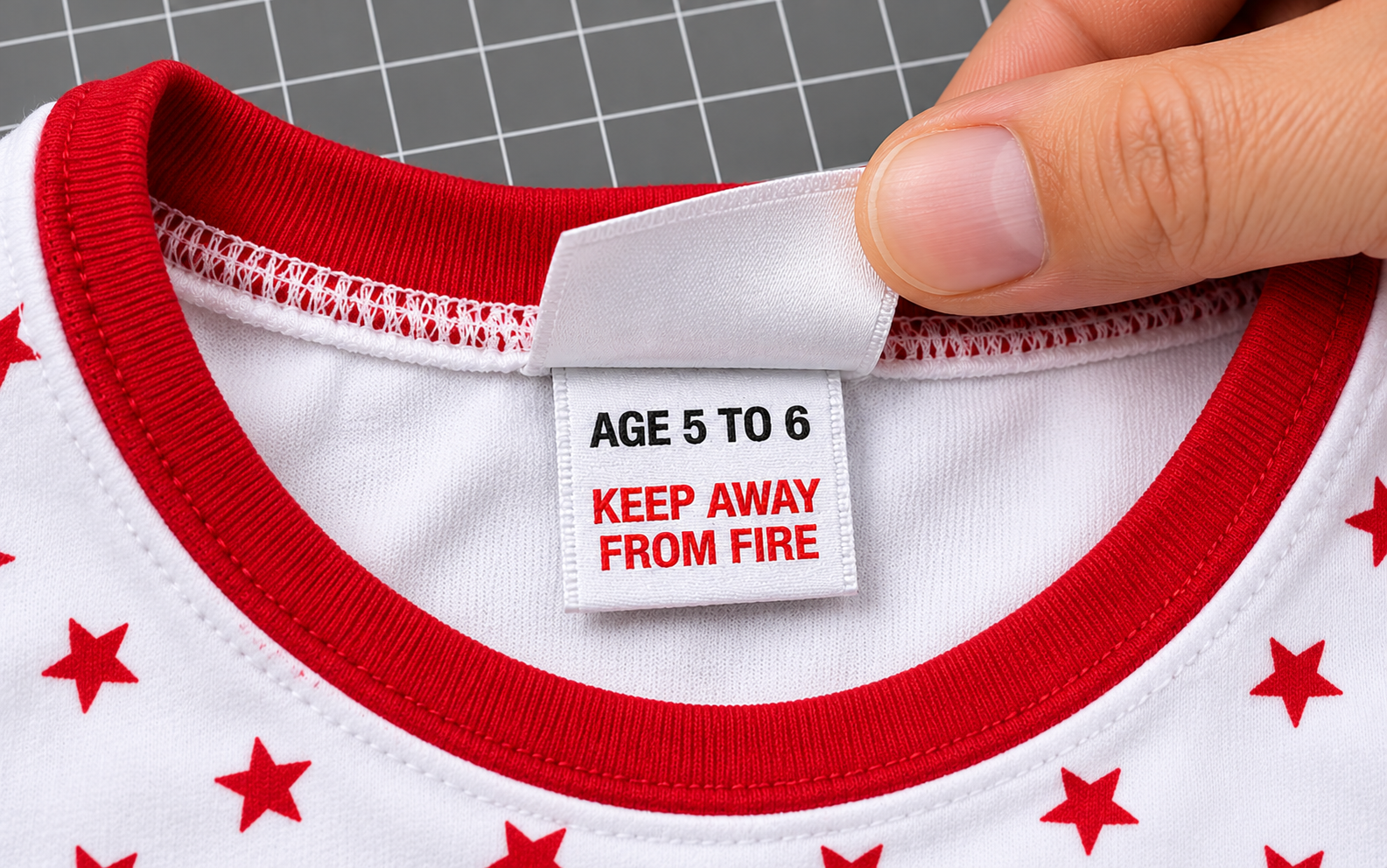 Listings have a rule as well. Business Companion, the Trading Standards guidance site for businesses (reviewed June 2024), says a mail-order or online advert for nightwear that does not meet BS 5722 shows KEEP AWAY FROM FIRE beside the item in a red-sided equilateral triangle; a compliant garment shows a green triangle with LOW FLAM. That is Schedule 4.
What a printer can and cannot do with a pyjama set
Nothing in the Regulations mentions printing or embroidery. A transfer on the chest does not remove the label at the neck, and a stitched name does not change the fabric. What a decorator cannot do is certify anything. BS 5722 is a laboratory test on washed fabric; a studio with heat presses and embroidery heads cannot run it, so a LOW FLAMMABILITY claim belongs to the garment maker's test report and nobody else. If the maker's label says KEEP AWAY FROM FIRE, a printer cannot upgrade it. There is a second limit, and we would rather state it than hide it. A DTF transfer is a layer of pigment ink and polyurethane adhesive bonded to the fibre at 150°C for 12 seconds. It is not a fabric, and we have found no published test of what a hand-sized film does to the burn behaviour of a cotton pyjama top. If the garment was flame-retardant treated, its label caps washing at 50°C, and we have no data on what a 150°C press does to that treatment. So we will not tell you a print makes no difference. Brandum does not stock pyjamas or any other nightwear. [OWNER TO CONFIRM] whether Brandum presses onto a customer-supplied pyjama top, and whether it will press onto a garment labelled keep away from fire. If the answer is yes for your garment, the standing terms for supplied garments apply: £1 handling per piece, at your risk. Brushed cotton and flannel shed lint, and lint plus moisture cause most transfer failures, so a smooth cotton jersey top is a better candidate than a fluffy one. One refusal applies to every garment: no film or TV characters, crests or brand logos without the owner's written permission, as the artwork policy sets out.The matching family set that is stocked: Christmas morning tees
The honest alternative is the one the studio prints every week. A Gildan Heavy Cotton 5000 for the adults, the 5000L in a ladies' cut and the 5000B for the children, all 180 gsm preshrunk cotton jersey in one colour, worn over the pyjamas on Christmas morning. Sold and worn as a t-shirt, it sits outside the nightwear definition in regulation 3. Call it a sleep tee on a listing and you have put it back inside. For the baby there is the BabyBugz organic baby t-shirt; the baby grows and bodysuits post covers the rest of the range and where a print can go on a 0 to 3 month garment. The zero-rating rules for children's sizes are in the children's clothing VAT post. Same-day printing is only on Gildan Heavy Cotton tees (5000, 5000L and 5000B), every colour and size kept in stock: artwork approved by 1pm, collect from the Forest Gate unit from 4.30pm, at £4.99 per garment on top of the garment and the print (the same-day page has the detail). No other garment is same-day, and pyjamas you bring in are not either. <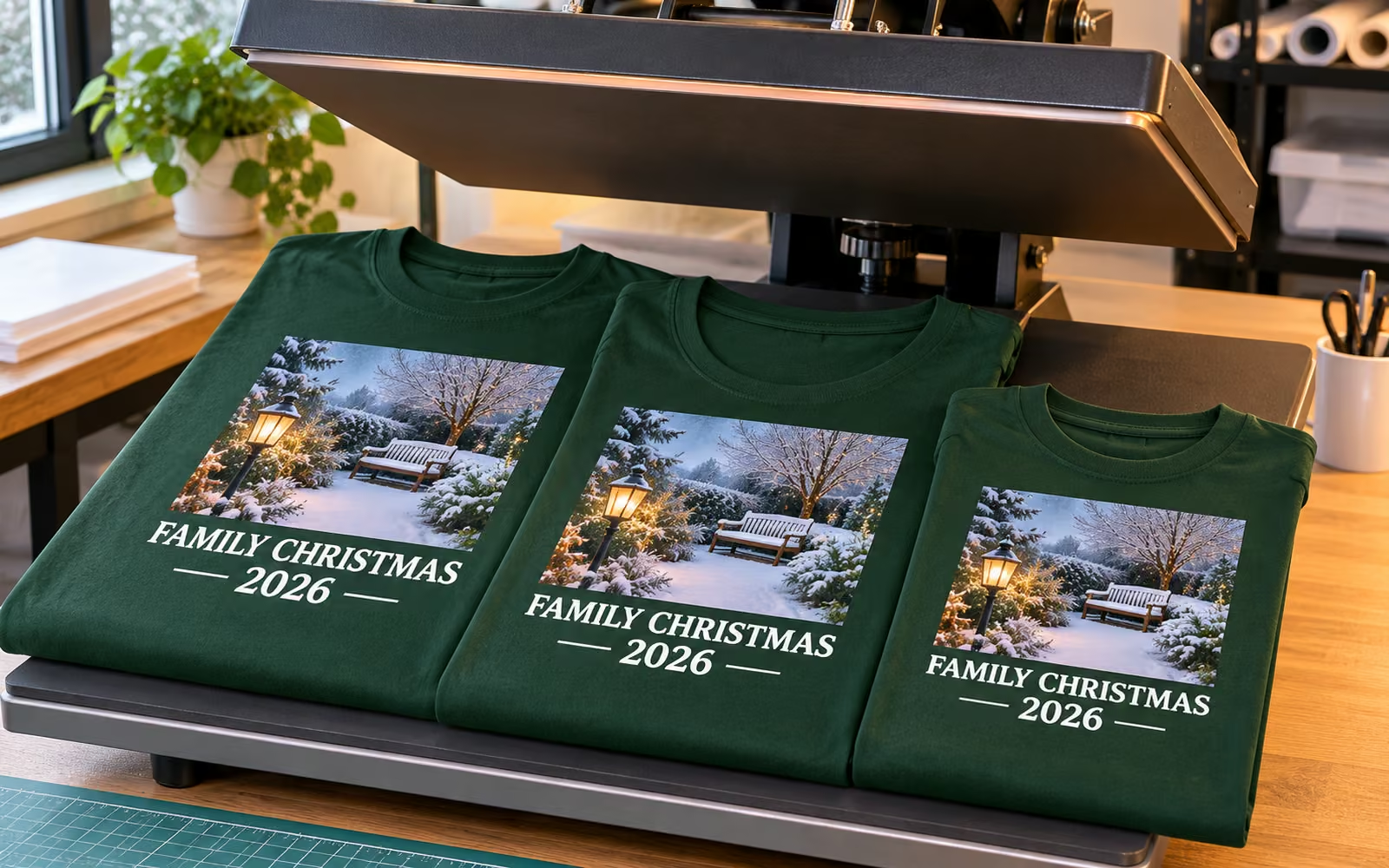 A family set is ordered one at a time through the shop with no minimum, each in its own size; names are £2.50 each. For the same photo on five tees and a bodysuit, use the quote form. The family holiday t-shirts page works the same way. Most English state schools break up between Friday 18 and Tuesday 22 December 2026, so check your school's term dates.
[OWNER TO CONFIRM] the last order date for guaranteed collection before Christmas.