
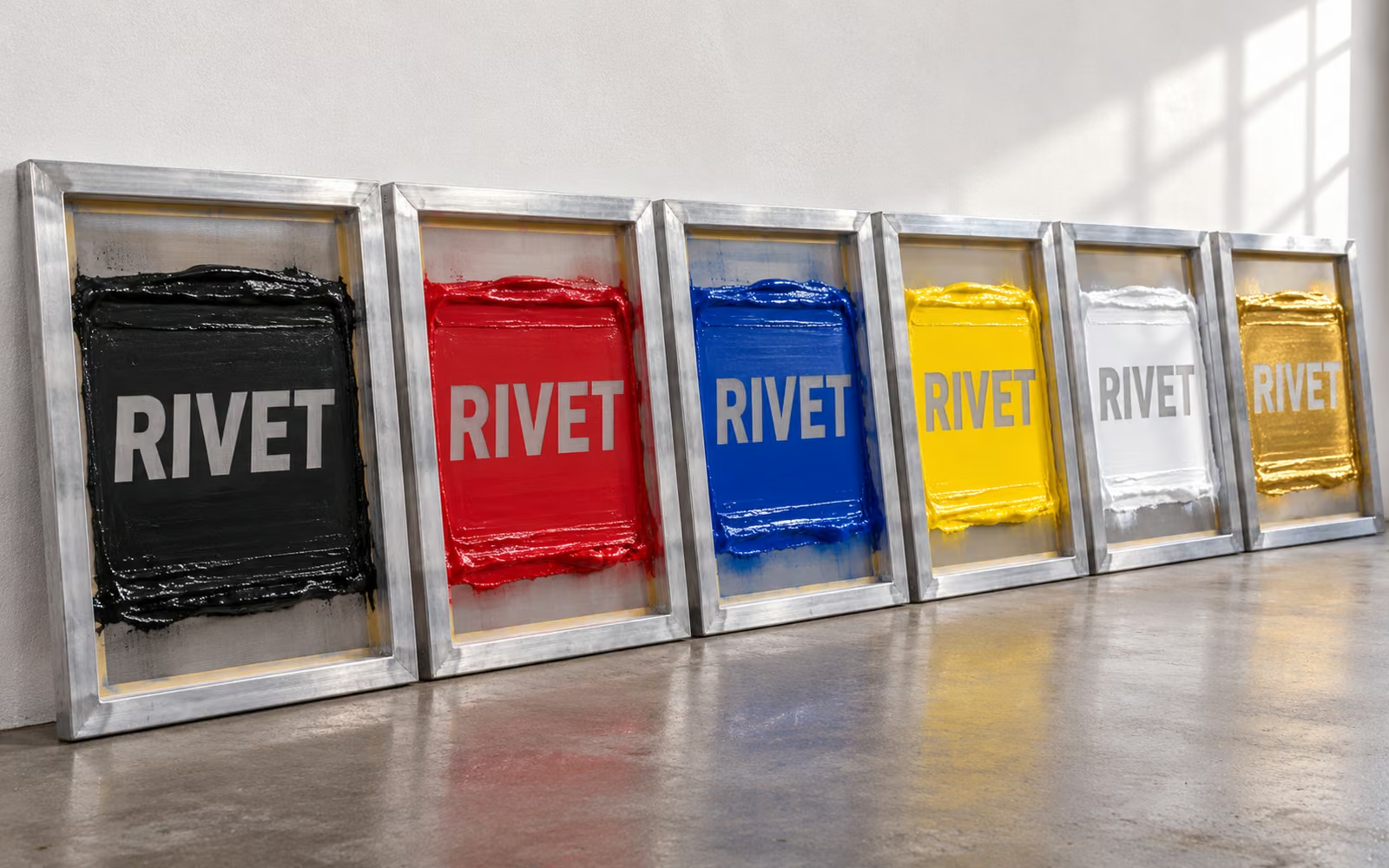
 Every screen printing technique on a quote comes back to one number: how many screens the job needs, because each colour is its own screen, set-up and pass on the press. This glossary covers spot colour, under-bases, halftones, simulated and CMYK process, discharge, puff, high density and foil: what each looks like, what it costs more for, what it cannot do, and which route at Brandum handles it as of November 2026.
Why the number of colours sets the price
A screen is a mesh stretched over a frame with a stencil of one colour burnt into it. One colour, one screen. A two-colour logo needs two films, two exposed screens and two set-ups on the press; a six-colour design needs six of everything, plus flash cures between colours that overlap. Before a single shirt is printed, the six-colour job has swallowed three times the screen work. That fixed cost is divided across the run. Over 500 shirts it almost disappears. Over 30 it is most of the bill. Brandum's worked price for a Gildan Softstyle 64000 tee with a one-colour front print is £8.50 each at 100 and £9.50 each at 50 (September 2026, no VAT added because Brandum is not yet VAT registered). Prints are priced per panel, so a back print is a second position with its own screens. One honest limit first. The Forest Gate studio runs DTF printers, embroidery machines and heat presses; screen printing is placed with partner printers for long runs, and short runs of the same artwork go out as DTF transfers. The print method guide walks through that choice. [OWNER TO CONFIRM] the minimum run Brandum's screen printing partners accept and the number of colours they will print.Spot colour, and the under-base on dark garments
Spot colour is what most quotes mean by "screen print": one solid, opaque ink per screen, mixed to a Pantone reference. It gives the sharpest edge, the brightest colour on a dark shirt and the longest wash life in this list. The ink is plastisol, water-based or discharge; the ink post covers that choice. On a white tee the colours print straight onto cotton. On black or navy they need a white under-base: white printed first, flashed until it gels, then the colours on top. A three-colour print on a black hoodie is therefore a four-screen job. Mesh decides how it feels. International Coatings' mesh selection guide (read November 2026) puts under-base white on 160 to 200 mesh "to create a softer overall feel", and drops to 110 to 155 only where a heavy deposit is wanted, such as white on black. Permaset's AQUA technical data sheet (May 2020 revision) uses its SUPERCOVER First Down White the same way, as an opaque under-base that also improves adhesion of the colour on top. A thicker under-base gives a brighter top colour and a stiffer print. The question printers hear every winter, how to get a softer print on a hoodie, usually has that under-base as its answer: fewer layers, a finer mesh, a flash just long enough to gel, and on 100 per cent cotton a discharge under-base instead of a white one. What spot colour cannot do: a gradient, a photograph or a soft shadow without the halftones below.Halftones: the dots that fake a gradient, and the mesh that carries them
A halftone breaks a tone into dots of different sizes, all printed in one ink. Big dots read dark, tiny dots read light, and from a metre away the eye blends them into shading. One screen, a whole fade. The dots have to survive the mesh. A dot smaller than a mesh opening falls through as nothing or merges with its neighbour. International Coatings' guide puts halftones, simulated process and CMYK on 230, 280 or 305 mesh ("low ink deposit, works well for halftone printing") and reserves 355 for 65-line and finer halftones. Most garment work sits coarser than that. Opaque inks set a second ceiling. Permaset's AQUA data sheet specifies its standard and process colours for 43 to 120T mesh (110 to 305 threads per inch) but caps its metallic, puff and SUPERCOVER opaque colours at 90T (225 threads per inch). A heavy white for a black shirt cannot carry a fine halftone.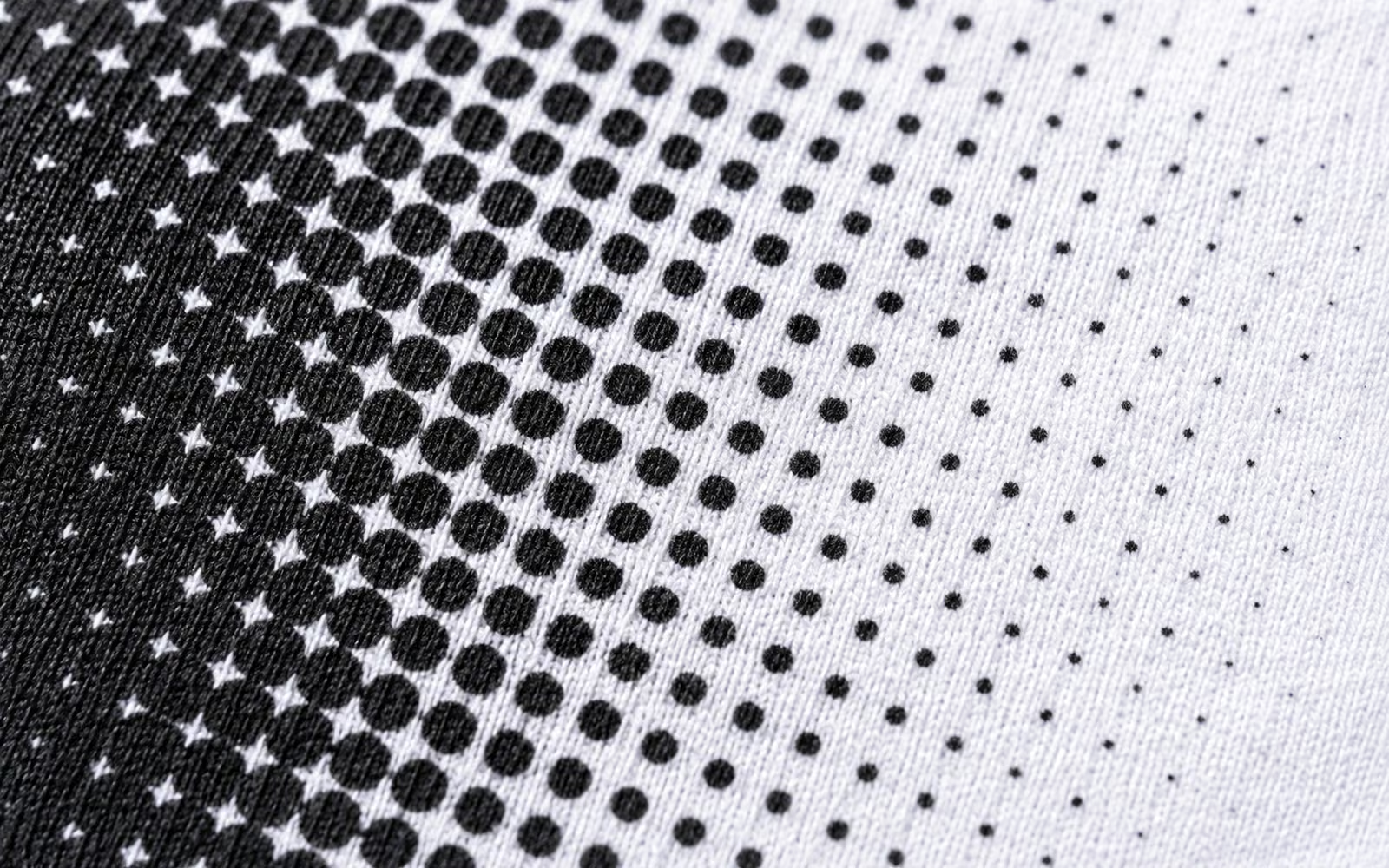 Send halftone artwork as a greyscale file at print size and let the printer apply the dots; a dot pattern baked into a JPEG gets re-screened into mush. Brandum's free halftone generator shows how a tone breaks into dots at a chosen frequency. What halftones cannot do: hold a tiny highlight on a dark garment, where the smallest white dots vanish first.
Simulated process and CMYK process: printing a photograph
Two techniques put a photograph on a shirt with screens. CMYK process uses four translucent inks, cyan, magenta, yellow and black, each halftoned at a different angle so the dots form a rosette rather than a moire. It works on white or very light garments because the inks borrow their brightness from the shirt. On black the picture goes muddy. Simulated process is the dark-garment answer: six to ten opaque spot colours, each halftoned and overlapped, with a white under-base below and a highlight white on top. That is the technique behind photorealistic band shirts on black. It needs a separator who knows how the inks will mix on press, and every screen has to register within a dot's width. The cost is the screen count again. Six to ten screens plus flashes only pay back on a long run. Under roughly 200 pieces they rarely do, which is why Brandum prints photographic designs on small and medium runs as DTF transfers: full colour, no screens, no separations, and Brandum's 50-wash test on Gildan Softstyle tees showed no failure. DTG is on request only, for volume cotton jobs. Sublimation is for polyester and starts at 200 garments; it does not work on cotton. Send the picture itself, not a mock-up: a layered file or a high-resolution PNG at print size, never a screenshot. Brandum's in-house designers check every file before it prints, free. What process printing cannot do: match a Pantone exactly (the colours are built from dots), or make sense on 25 shirts.Discharge: the soft print that only works on cotton
Discharge ink does the opposite of everything above. It carries an activator that strips the garment's own reactive dye where it is printed, and a pigment settles into the bleached cotton in its place. Cure it and the print is the fabric: no raised edge, no plastic hand, nothing to crack. The limit is absolute. Discharge only works on 100 per cent cotton dyed with dischargeable dyes. A solid-colour Gildan Heavy Cotton 5000 discharges; the sport grey and heather shades of the same shirt are cotton and polyester blends and come out mottled. A Gildan Heavy Blend 18500 hoodie is 50/50 and will not discharge at all, because polyester is dyed through the fibre. Black garments vary by dye lot, so a printer tests a shirt from the actual box. What it costs more for: the activator is mixed in on the day and has a working life of hours, so leftover ink is waste; the garment has to be cured hot; and the result is a bone white or a tinted shade rather than a pure pigment colour, so a test print is part of the job. What it cannot do: print on polyester or blends, hit a precise Pantone (the shade depends on the shirt), or give you a bright white. Wash it below 30°C and inside out, like any print.Raised and shiny: high density, puff and foil
High density makes a logo stand up off the shirt with a flat top and a vertical edge, like a slab of rubber. It comes from the stencil, not the ink. A standard emulsion stencil is 35 to 70 microns on International Coatings' additive sheet; a high-density stencil is several times that, printed through coarse 60 or 86 mesh in two or three passes with a flash between each. Slow, and only for bold shapes: no fine lines, no small text. Puff is the softer cousin. A blowing agent is stirred into ordinary plastisol, at most 10 to 15 per cent by weight on the same sheet, and expands in the dryer into a rounded dome. Permaset lists a water-based AQUA Puff Paste too. Puff cannot hold detail and rounds every corner.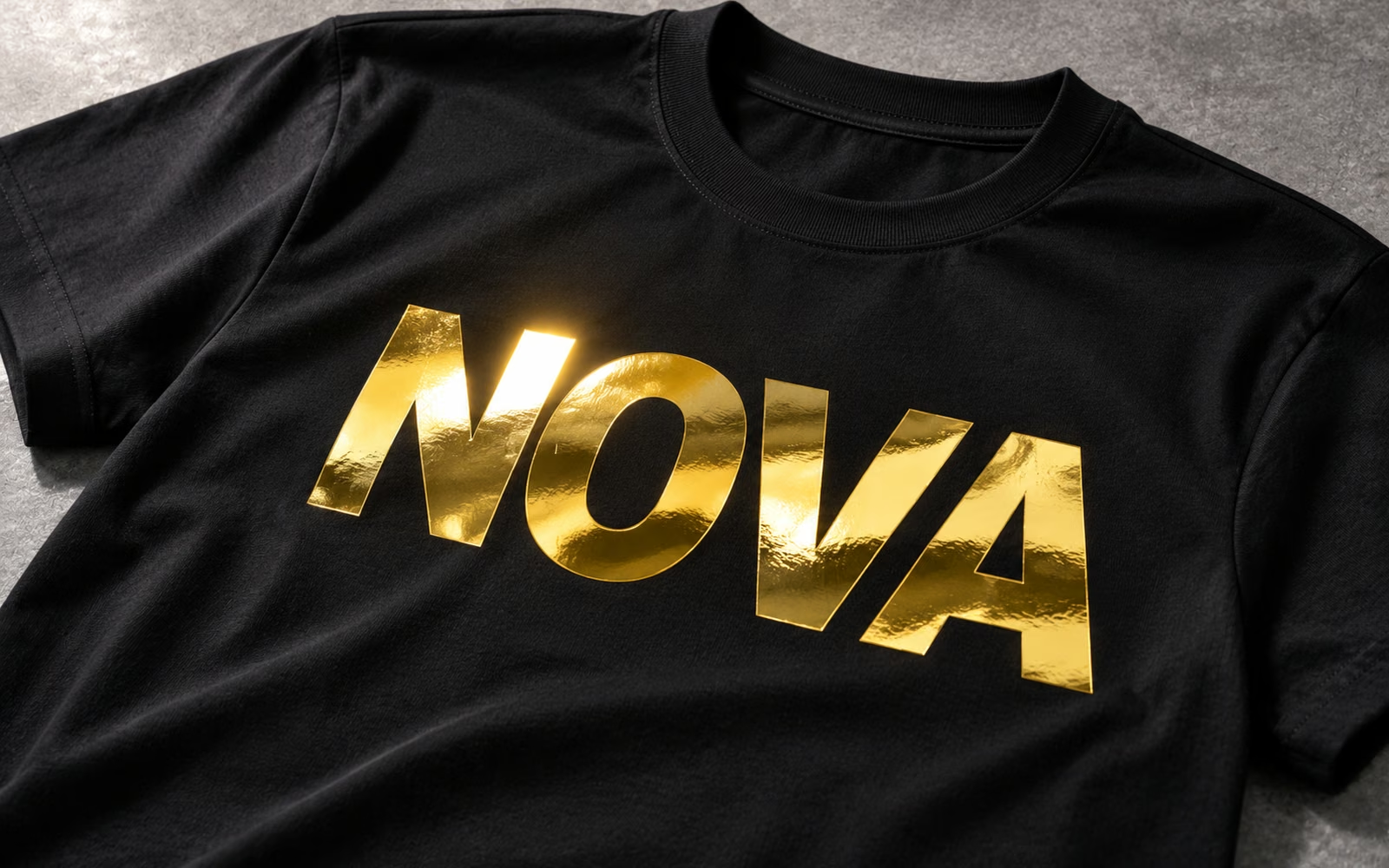 Foil is two steps. An adhesive is screen printed where the shine should go: International Coatings' Foil Adhesive 3801 bulletin (read November 2026) specifies 86 to 110 threads per inch on t-shirts and 74 to 86 on sweatshirts, then a spot flash until it is dry to the touch. A sheet of foil is laid over the print, heat pressed at 149 to 163°C for 10 to 15 seconds, cooled for 20 to 30 seconds and peeled. The foil stays only where the adhesive was.
Now read the wash care on that bulletin: hand wash or a delicate cycle, inside out, line dry, no bleach, no iron. That rules foil out for workwear and uniforms that go through a hot wash every week.
Which route handles each technique
How the techniques map to the way Brandum takes a job in, as of November 2026.| Technique | Best for | Stops working when | Route |
|---|---|---|---|
| Spot colour, 1 to 3 screens | Logos on long runs; exact Pantones | Short runs; gradients | Screen printing partner; DTF on short runs |
| Halftones | Shading in one or two inks | Tiny highlights on dark garments | Either route |
| Simulated or CMYK process | Photographs on long runs | Under roughly 200 pieces | DTF transfers |
| Discharge | Soft prints on 100 per cent cotton | Blends, polyester, exact colours | Screen printing partner |
| Puff and high density | Bold raised shapes | Fine lines, small text | Screen printing partner |
| Foil | Event and fashion pieces | Workwear, hot washes | Screen printing partner |