
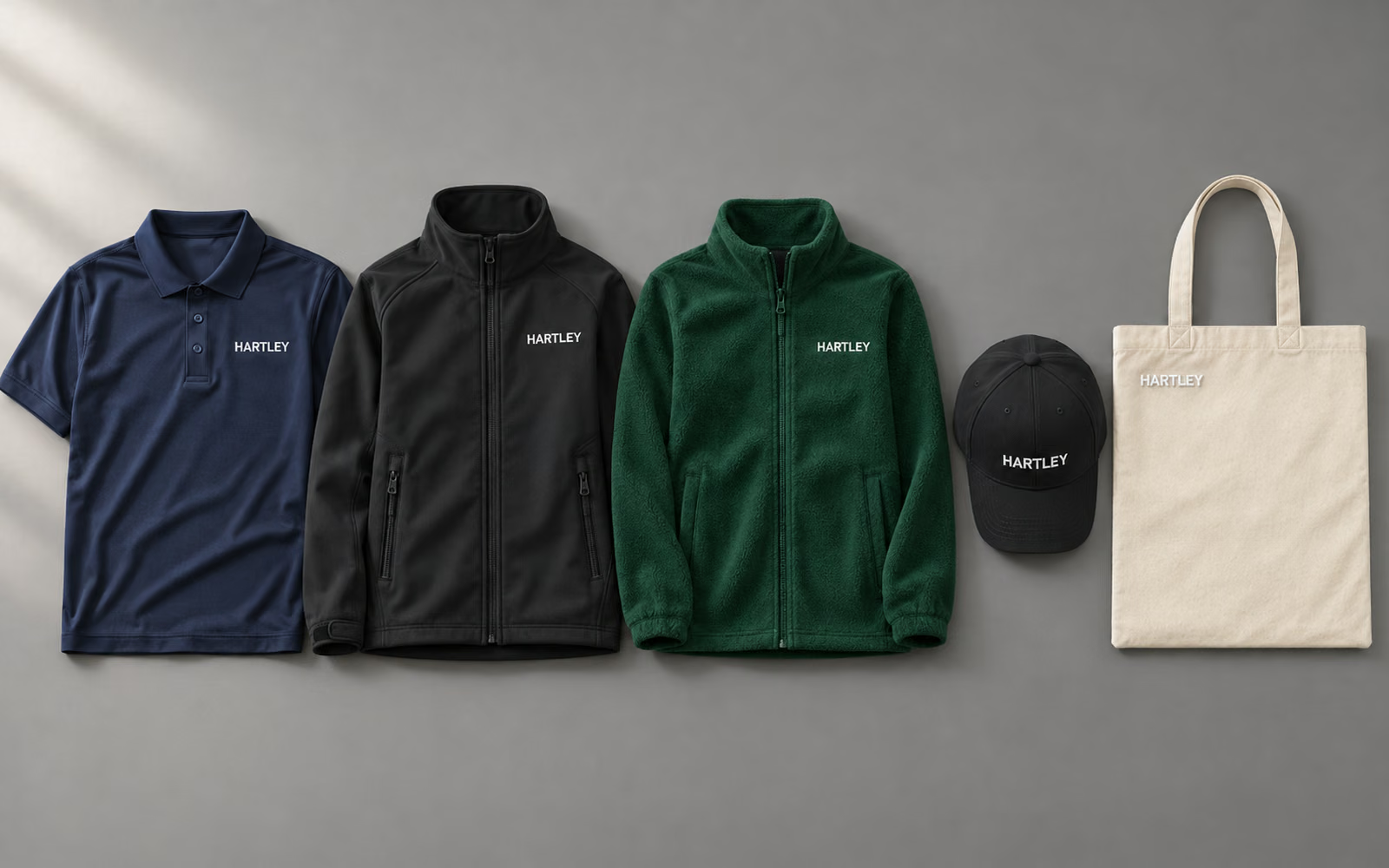
 Yes, you can embroider polyester, and most of the other garments people ask about: softshells, fleeces, caps, beanies, aprons, tabards and bags. The exceptions are taped waterproof shells, stretch lycra and thin faux leather, and the reasons are below, garment by garment. The same embroidery numbers apply to all of them: digitising £20 once per logo, stitching within 24 hours of proof approval, no text under 4 mm.
The short answer, garment by garment
Embroidery asks three things of a garment: hold still in a hoop, take a needle hole without damage, and give the stitches a surface to sit on. The fabrics that fail, fail on the needle hole or on stretch, and no backing fixes either.| Garment | Embroider it? | What makes it work |
|---|---|---|
| Polyester polo or sports top | Yes | Cut-away backing, lighter density, topping on piqué |
| Softshell jacket | Yes | Bonded membrane, seams not taped |
| Taped-seam waterproof shell | No, print instead | Every stitch is a hole through the membrane |
| Fleece | Yes | Topping film keeps stitches above the pile |
| Leather and faux leather | Patches and some caps | One pass, needle marks are permanent |
| Caps and beanies | Yes | Cap frame, height limit on the front panel |
| Silk and satin | Not for workwear | Holes and hoop marks show |
| Stretch lycra | No | The stitched area cannot stretch |
| Aprons, tabards, bags | Yes | Lined bags are opened so the hoop reaches |
| Over an old logo | Sometimes | New design covers it fully, old stitches flat |
Can you embroider polyester? Polos and sports tops
Yes. Polyester is one of the easier fibres to embroider; the faults blamed on it are faults of the knit. A performance polo or a Just Cool wicking tee stretches in the hoop and relaxes when it comes out. Hooped tight and stitched densely, it relaxes around a logo that cannot move: that is puckering. Madeira's technical FAQ (read November 2026) puts the cause plainly: fabric that is not framed firmly enough will pucker, except knitwear, which "shouldn't be framed with too much stretch", and the cure is to bond fabric and backing together and "always choose the smallest needle possible". Gunold's stabiliser guide (8 February 2023) adds the backing rule: small fonts and fine detail call for a cut-away, which stays in for life; large open designs can take a tear-away. So a polyester polo gets a cut-away, a lighter density than the same logo on cotton drill, and on piqué a thin water-soluble film on the face so lettering does not drop between the ribs. Thread shrinkage is a viscose worry, not a polyester one: neither the fabric nor a polyester thread shrinks at 40°C. Embroidery also takes a hotter wash than a print.Softshells, waterproofs and fleeces
A softshell takes a left-chest logo well. Result's technical guide (resultclothing.com, read November 2026) describes its three-layer softshell as outer and inner fabrics bonded around a TPU membrane, rates its HydraDri bonded fabric to 3000 mm of water, and says the garments are "designed to take decoration with hidden access points". The Result recycled printable softshell in the shop is that construction. The needle perforates the membrane, but a softshell is showerproof, not sealed, so a 60 mm chest logo changes nothing in rain. A taped-seam waterproof is different. Every stitch is a hole through the membrane, and a left-chest logo is 3,000 to 8,000 holes in a block exactly where water runs off your collar. No spray puts the seal back. So a fully taped shell gets a DTF transfer at the 135°C polyester setting instead; Result tells decorators to test before bulk decoration, so ask for one jacket first. [OWNER TO CONFIRM] whether the studio embroiders customer-supplied leather or faux-leather items, and whether it embroiders sealed waterproof shells at all.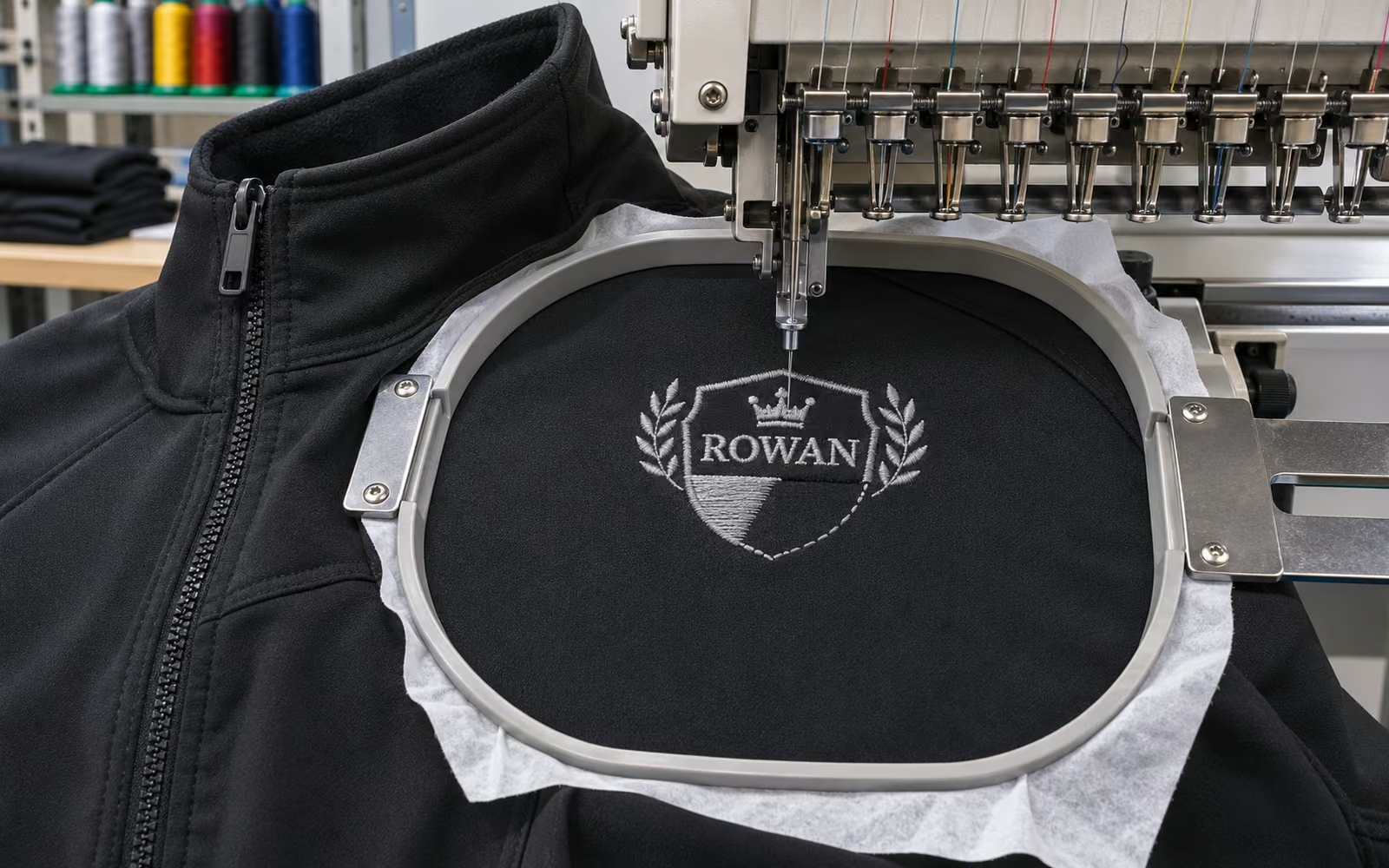 Fleece is a yes, with one extra layer. Stitches sink into pile, so a water-soluble film goes on top before stitching and is torn away after. Gunold's guide to its Solvy topping says it stops "the stitches from getting lost in (sinking into) the fabric". Without it, 5 mm lettering on a mid-weight fleece reads as a fuzzy line. Weights and positions are in custom fleeces for work and teams.
Caps, beanies, leather and faux leather
Caps go on a cap frame, not a flat hoop. The frame holds the front panel in a curve and drives it under the needle; Tajima's frame specification (tajima.com, read November 2026) gives embroidery up to 270 degrees round the cap and up to 360 mm long. Height is the limit: a structured six-panel cap gives a field of roughly 55 to 60 mm above the sweatband seam, so a logo 120 mm wide and 50 mm tall fits and a round 70 mm crest does not. [OWNER TO CONFIRM] the maximum front-panel logo height the studio quotes on a structured cap. 3D puff needs a structured front with buckram behind it, because a soft crown lets the foam crease, and bold letters, because a thin stroke cannot hold foam. A five-panel cap has one wide front panel with no centre seam, the largest field a cap offers. A mesh-back trucker takes flat embroidery or a patch on its foam front, covered in custom trucker caps. Beanies are hooped flat on a cut-away with a topping, because rib knit swallows stitches; the logo goes on the turned-up cuff. Leather is a yes with a condition: you get one go. Every needle hole is permanent, so a misplaced stitch cannot be unpicked, and a dense fill cuts the hide into a perforated line that can tear out. It works on a leather patch, on a firm faux-leather cap front or peak, and on thick faux leather bonded to a woven. It does not work on thin faux leather, the PU-coated knit on cheap jackets: the coating cracks round the stitches and the knit beneath stretches. For a leather jacket you care about, a sew-on embroidered patch at £6.50 each, minimum 25, is the safer route.Silk, satin and stretch lycra: what we say no to
Silk and satin can be embroidered, and we do not recommend it for workwear. Needle holes in a tight filament weave are permanent and show as a pale halo if the logo ever comes off. The hoop leaves a ring on satin that does not always steam out. And a thin fabric needs a backing that shows through from the inside as a stiff square. Gunold's guide gives the rule: thin fabric, thin stabiliser, so the garment does not bulge or scratch, and it names its water-soluble Solvy Fabric for light fabrics because nothing is left behind. That suits a robe worn once; for a satin reception uniform washed weekly, a woven label or a print is the honest answer. Stretch lycra is a straight no. A running tight with 15 to 20 per cent elastane stretches in four directions; an embroidered logo stretches in none. Pull it on and the fabric round the logo lengthens while the logo stays put, so the fabric waves, the logo lifts into a stiff dome and the cut elastane fibres run. A heat-applied transfer moves with the fabric; what works on tights and base layers is in printing on base layers and thermal tops.Aprons, tabards and bags
All three are a yes, and simple to hoop because they are flat. A bib apron takes a chest logo at 80 to 100 mm wide; in the September 2026 worked prices an apron with an embroidered logo came out at £16.50 each on a run. A Premier pocket tabard is a stable polycotton that takes a chest logo one side and a name the other at £2.50 a name; personalised tabards has the positions. Bags are a yes if the hoop reaches. A cotton tote is one layer and hoops like a t-shirt. A canvas duffel or a backpack has a lining the outer cannot be hooped away from, so a lined bag is opened at an inside seam, stitched, and closed again on the studio's sewing machines. That labour sits on top of the stitch count. A padded laptop sleeve behind the logo position means a sewn-on patch instead, and zipped pockets and webbing straps are not hooped.Can you embroider over an existing logo?
Sometimes. The old logo must be flat stitching (fill or satin, not 3D puff or thick appliqué) and the new design must be a solid fill that covers it completely with a margin all round. Stitching through an old fill doubles the thickness under the needle, so the new logo is digitised denser with a cut-away behind it, and the stitch count rises. An outline, lettering alone or a smaller logo does not work: the old stitching shows through the gaps. A company hoodie with an old 90 mm badge under a new 100 mm solid crest works. A fleece with an old 3D puff logo does not, and nor does a logo that has to move 20 mm to sit centred, because the old one would peek out. Then the old embroidery is cut out first, leaving holes and a ghost; the removal guide says which fabrics recover. Fleece does, because the pile closes over the holes. Polyester microfibre does not.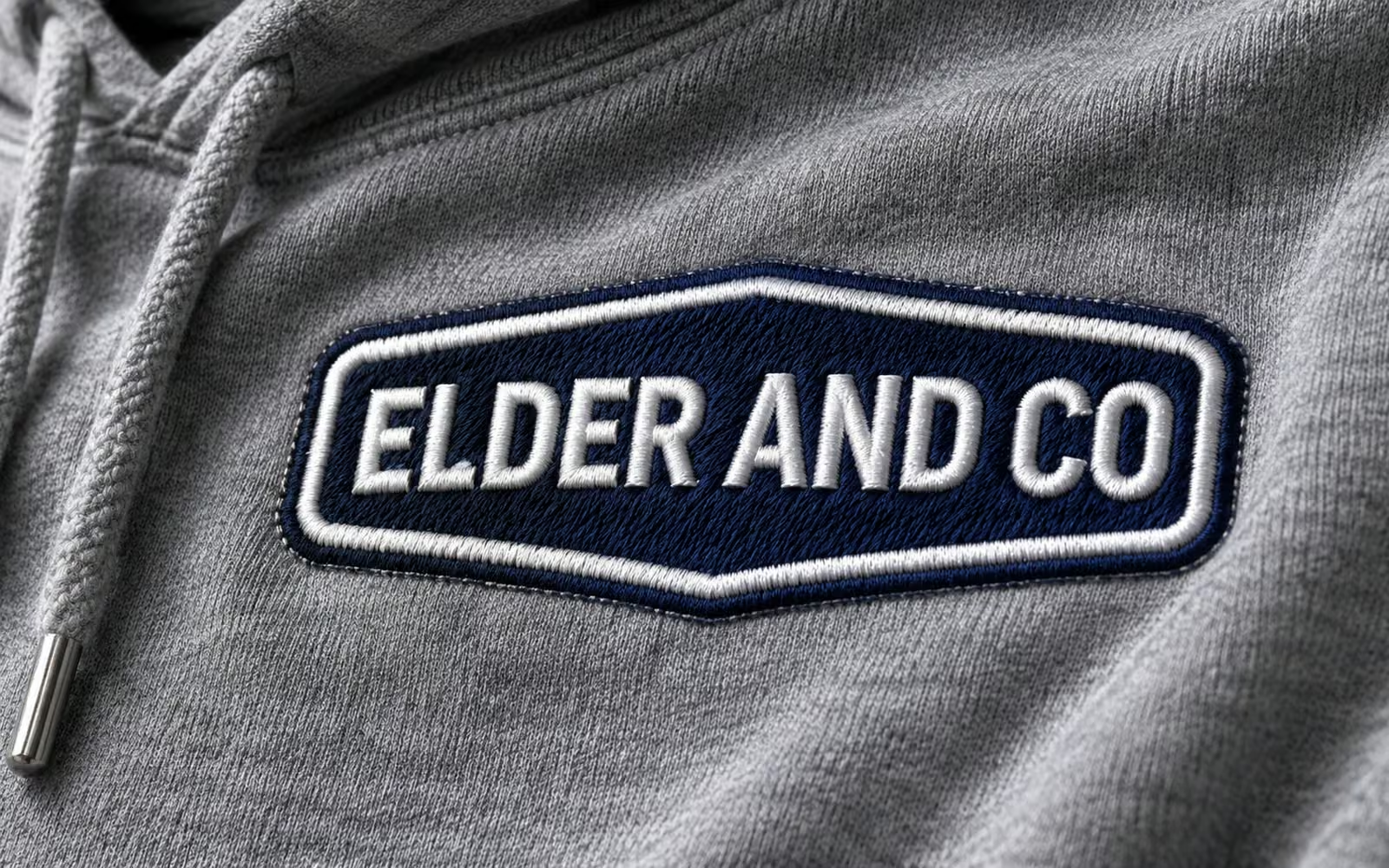
Prices, timings and the garments we send back
The same numbers apply to every garment on this page, as of November 2026.- Digitising is £20, once per logo, not charged again on a repeat. Embroidery is priced by stitch count, so a 4,000-stitch left-chest logo costs less than a 12,000-stitch back crest.
- Embroidery is done within 24 hours of proof approval.
- Text under 4 mm loses its lettering; the gaps in an e and an a close up. How small can embroidered text go has the sizes font by font.
- Your own garments are welcome at £1 handling each, at your risk. That matters more in embroidery than in print, because a needle hole cannot be undone. Print on your own garments explains the handling line.
- On a run of 20 we recommend two spares: a mill flaw or a thread break on one garment is cheaper covered than reordered.
- No minimum order, and every order is paid before production because a stitched garment cannot be resold.