
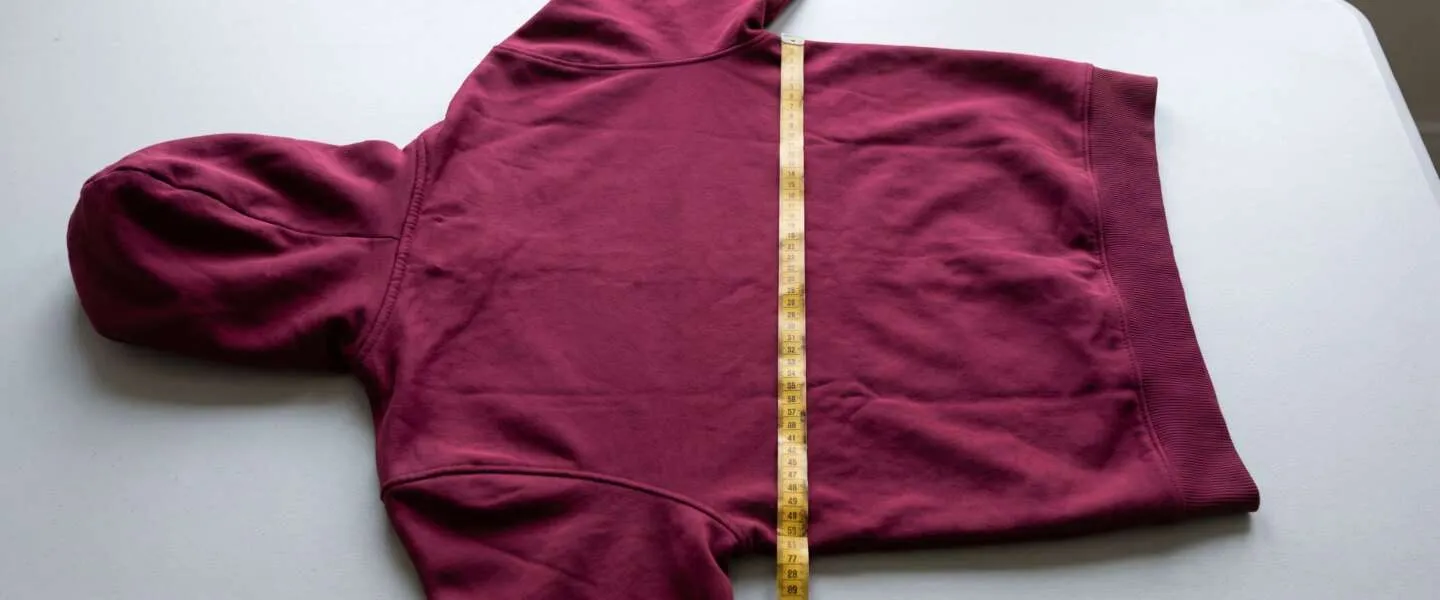
Yes, a little, and how much depends on the cotton. A 100% cotton knit lost 4.5 to 7.3% of its length in Cotton Incorporated's wash tests, an 80/20 Just Hoods JH001 moves less, and a 50/50 Gildan 18500 barely moves at all. The print itself never shrinks. Below: the figures by fabric, what pre-shrunk really means, why the fleece can pucker around a big print, the wash and dry rules, and how to size a printed hoodie run.
How much does a hoodie shrink? The numbers by fabric
Start with the fibre, because it decides nearly everything. Cotton swells in water, and the knitted loops relax when they're wet and agitated, so a cotton fleece pulls in, mostly in length. Polyester does neither at domestic wash temperatures. A hoodie's shrinkage is its cotton content doing what cotton does, with the polyester holding it back.
The best public figures come from Cotton Incorporated's technical bulletin ISP 1009, A Guide to Improved Shrinkage Performance of Cotton Fabrics (the edition on cottoninc.com as of September 2026). Using the AATCC 135 home-laundering method, a 100% cotton single jersey that had only been relax dried at the mill lost 7.3% in length and 3.5% in width. The same fabric after mechanical compaction, which is what a "pre-shrunk" label means, lost 4.5% in length. So the honest range for a pure cotton garment is 4 to 7% in length: the low end if it was compacted at the mill, the high end if it wasn't.
Put that on a hoodie with a 70 cm body. Then 3% is 2.1 cm, 5% is 3.5 cm and 7% is nearly 5 cm off the hem. Width barely moves and sometimes grows a touch, which is why an old cotton hoodie ends up short and boxy rather than smaller all over.
Blends move less, in rough proportion to their cotton share. Here are three UK blanks and what their makers publish, as of September 2026. The last column is arithmetic from the cotton share, not a lab result, so treat it as a planning figure and measure your own if the run matters.
| Hoodie | Fabric | Weight | Maker's care label | Length shrinkage to plan for |
|---|---|---|---|---|
| Just Hoods JH001 College Hoodie | 80% ringspun cotton / 20% polyester (Heather Grey 75/25, Black Smoke 70/30, Charcoal 52/48) | 280 gsm | Wash cold, tumble dry low, iron cool, do not bleach | About 2 to 4% |
| Russell 265M Authentic Hooded Sweatshirt | 80% cotton / 20% polyester | 280 gsm | See the sewn-in label | About 2 to 4% |
| Gildan 18500 Heavy Blend | 50% cotton / 50% polyester (heathers 40/60) | 8.0 oz/yd², about 271 gsm | Gildan's spec page gives no wash temperature; see the sewn-in label | About 1 to 2% |
| Any 100% cotton fleece | 100% cotton | Varies | Varies | 4 to 7% (measured, Cotton Incorporated) |
The JH001 and Gildan figures are from AWDis's JH001 page and Gildan's 18500 page, both read in September 2026. Note the colour exceptions on the JH001. A Charcoal one at 52/48 will behave more like the Gildan, so a mixed-colour run in one size can come out of the wash at slightly different lengths.
What "pre-shrunk" actually means
Pre-shrunk is a finishing step, not a promise. At the mill the fabric goes through a compactor, which overfeeds it between belts or rollers so the knitted loops are forced shorter and rounder. The elastic shrinkage that would otherwise happen in your machine happens in the factory instead. Cotton Incorporated's bulletin puts it the same way: a shorter, rounder loop gives a lower length shrinkage number.
What compaction doesn't remove is drying shrinkage, the pull-in that happens as swollen cotton fibre dries and deswells. That's why the compacted jersey in the bulletin still lost 4.5%, not zero. Read pre-shrunk as "less", never "none". It's a reason to expect the low end of the range and to skip the size-up you'd give an unfinished cotton garment.
Two findings in that bulletin surprise people. The three temperatures it tested, 100°F, 150°F and 200°F (38°C, 66°C and 93°C), gave identical shrinkage curves. Drying method did not: line or flat drying released mostly the elastic shrinkage, while tumble drying, in the bulletin's words, realised "all available residual shrinkage". For size, the dryer is the villain, not the hot wash. The hot wash is the print's problem, which is next.
Why the print stays put while the hoodie shrinks around it
A DTF transfer is a printed film bonded to the fleece by a hot-melt adhesive. There's no cotton in it. We press it at 150°C for 12 seconds after a 2 second pre-press to drive out moisture (the full recipe is in our heat press settings guide), and from then on the print is a fixed size. When the knit under it relaxes by 3%, the print doesn't, so the fabric has to give somewhere.
On a left-chest logo you'll never notice. On an A3 back print with large solid areas, the fleece around the print can ripple, and the print edges get tugged every wash. That tension plus heat is what turns into cracking on a heavy cotton hoodie that's washed hot and tumbled hot. Screen print ink sits in the fibres rather than as one continuous film, so it flexes a little better, but it doesn't shrink either, and a big block of it on pure cotton cracks sooner for the same reason.
Embroidery copes best. The crest is polyester thread through a stabiliser, so the fabric under the stitches is locked and any movement happens in the fleece around it. That's also why an embroidered hoodie can be washed hotter than a printed one.
So printing neither causes shrinkage nor stops it; a cotton hoodie loses the same 4 to 7% printed or plain. What changes is the cost of a wrong wash: a shrunk plain hoodie is short, while a shrunk printed one can also be puckered or cracked. If a transfer does lift or crack, the causes and fixes are in our peeling, cracking and lifting guide, and most trace back to the press (moisture in the fabric, lint under the film), not the wash.
The wash and dry rules that keep the size and the print
Prints go below 30°C, inside out. That's our wash rule for anything printed, and it lines up with the Just Hoods label, which says wash cold. Inside out keeps the print face off the drum and away from other garments' zips. Our 50-wash test on Gildan Softstyle tees showed no failure, and the studio has never had a print complaint.
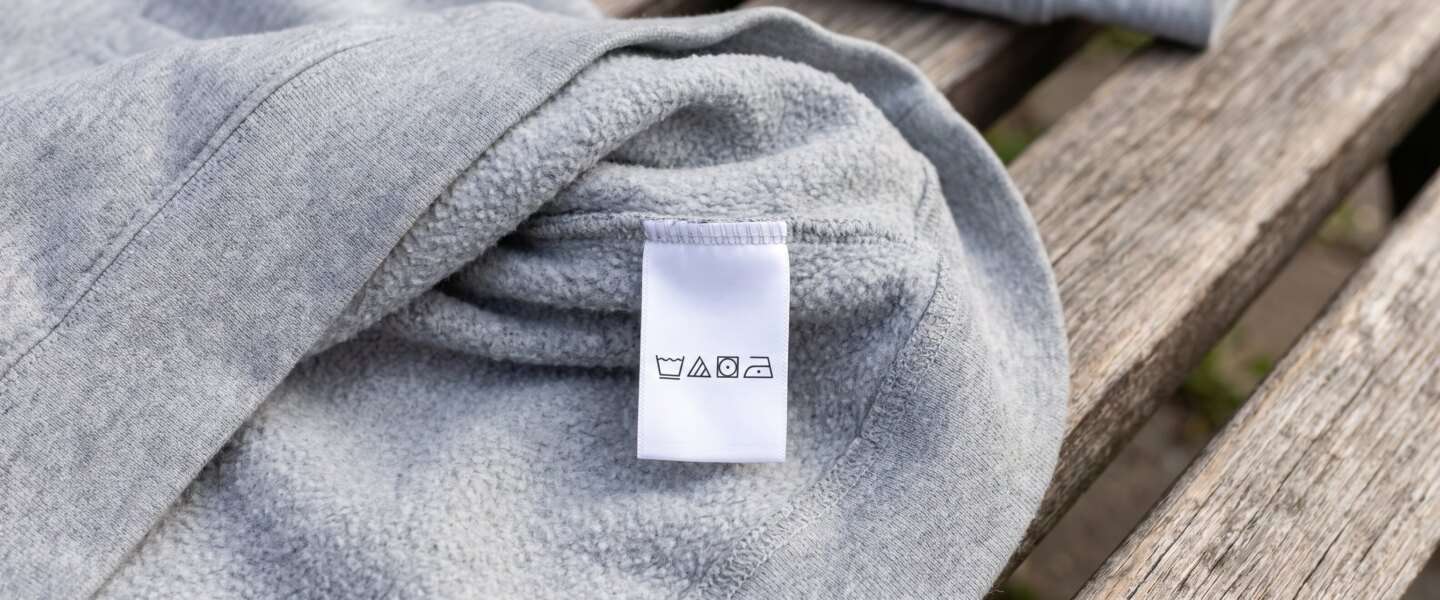
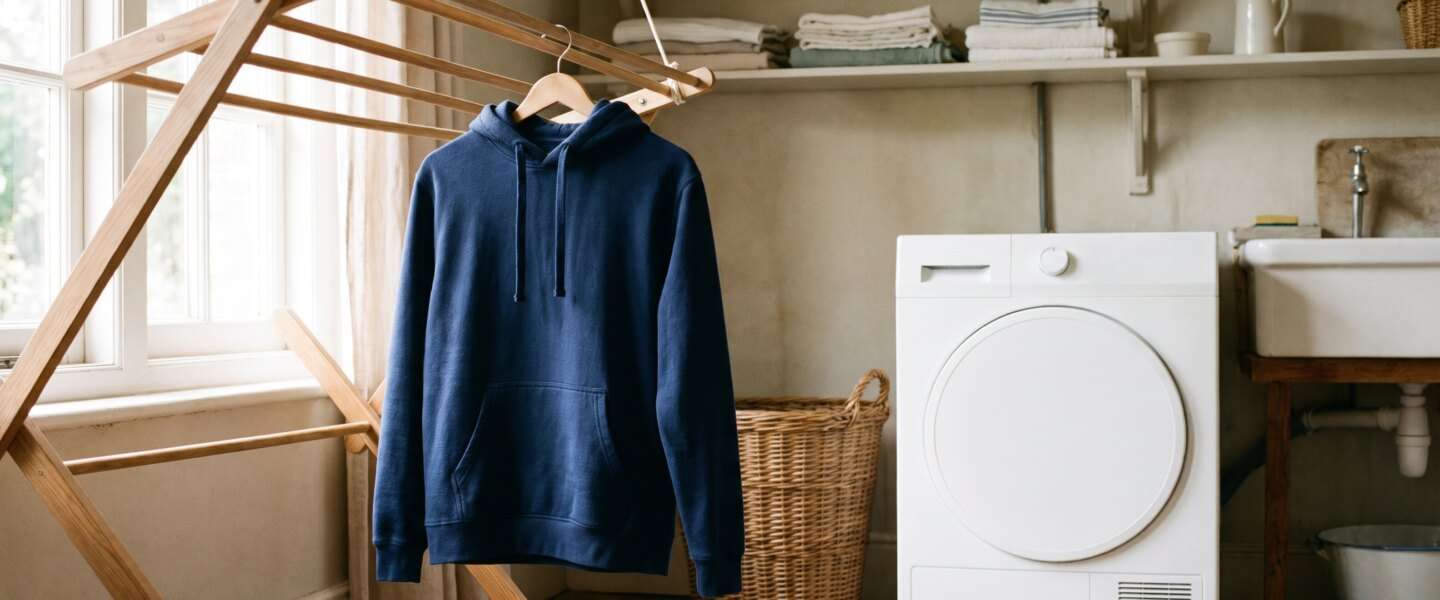
Drying is where the size goes. Hang a cotton hoodie and it gives up mostly its elastic shrinkage; tumble it and it gives up all of it, per the Cotton Incorporated tests. The JH001 label says tumble dry low. If it must be dry tonight, use low heat and pull it out while it's still slightly damp.
A dryer on high is a long way below the 150°C the print was bonded at, but it's plenty hot enough to finish shrinking the cotton and to shorten the print's life. Embroidery can go hotter. A 40°C wash on an embroidered crest is fine; at that point you're looking after the fleece, not the stitching. Iron cool if you must (the JH001 label says iron cool), never on the face of a print, and don't bleach.
How to size a printed run when shrinkage is expected
The honest method is to measure, not to guess a size up. For a club, society or team run, the sequence is:
- Order one sample in the exact blank and colour you'll use. There's no minimum order here, so a sample of one is a normal order, and blanks from the major brands arrive next day if ordered and paid before 4.30pm.
- Measure it flat: body length from the high point of the shoulder to the hem, chest 2.5 cm below the armhole, sleeve from shoulder seam to cuff.
- Wash and dry it the way your members will, not the way the label says. If half of them tumble on high, tumble it on high. AATCC 135 runs at least five cycles for a full figure; three shows you the direction.
- Measure again. The difference as a percentage is your number for that blank in that colour.
- Size the run against the washed measurements, not the brand's size chart.
No time for a sample? Use the fabric. A 50/50 like the Gildan 18500: order true size. An 80/20 like the JH001 or Russell 265M: order true size; a 2 to 3% loss on a 70 cm body is 1.5 to 2 cm, which most people won't notice on a relaxed fit. A 100% cotton hoodie: true size if the wearer washes cold and hangs, one size up if they tumble on high, and tell them which you assumed.
Two things about the order itself. Add two spares on a run of 20: someone always wants a swap after the first wash, custom goods cannot be resold, and two spares at the run price beat a second order of one plus another £15 delivery. If you're adding names (£2.50 each), hold the name list until after the sample wash. The rest of the pre-order mechanics (size collection, deposits, cut-off dates) are in our guide to running a club merch pre-order.
Which hoodie to choose, and what a printed run costs
If shrinkage is the worry, buy polyester content. The Gildan 18500 Heavy Blend (50/50, 8.0 oz, classic fit) is the stable choice for anything that will be washed carelessly, like a kids' club hoodie or a uniform that goes through a hot commercial wash. The trade-off is feel: half polyester is slicker and less soft than a ringspun cotton-rich fleece.
The Just Hoods JH001 (80/20 ringspun, 280 gsm, relaxed fit) is the college-style hoodie: heavier, softer, with a brushed inner fleece and a double-fabric hood. It moves more than the Gildan but far less than pure cotton, and a cold wash with a low tumble keeps it true. Russell's 265M Authentic sits in the same 80/20, 280 gsm class. Pure cotton and organic hoodies are lovely to wear and are the ones you size and wash with care; if you want one, do the sample wash first.
Prices, September 2026, with no VAT added because Brandum is not yet VAT registered. Twenty JH001 hoodies with an embroidered crest and an A3 back print cost £25 to £32 each depending on stitch count; at 50, the hoodie price drops to £24 each. Digitising the crest is £20, once per logo, and often waived on orders over £500. Every job gets a free artwork check.
Bring your own hoodies through print your own and it's £1 handling per garment, at your risk. One that's already been through a few washes has done its shrinking; an unwashed one will still shrink around the print later. Either way it must arrive dry and lint-free, because lint under the film is one of the two main causes of a failed transfer.
All orders are paid before production. Collect from the unit in Forest Gate, E7 8DN, or UK delivery is £15 per address on business orders. For a price on your own run, send the blank, the colour, the sizes and the artwork through the quote form.