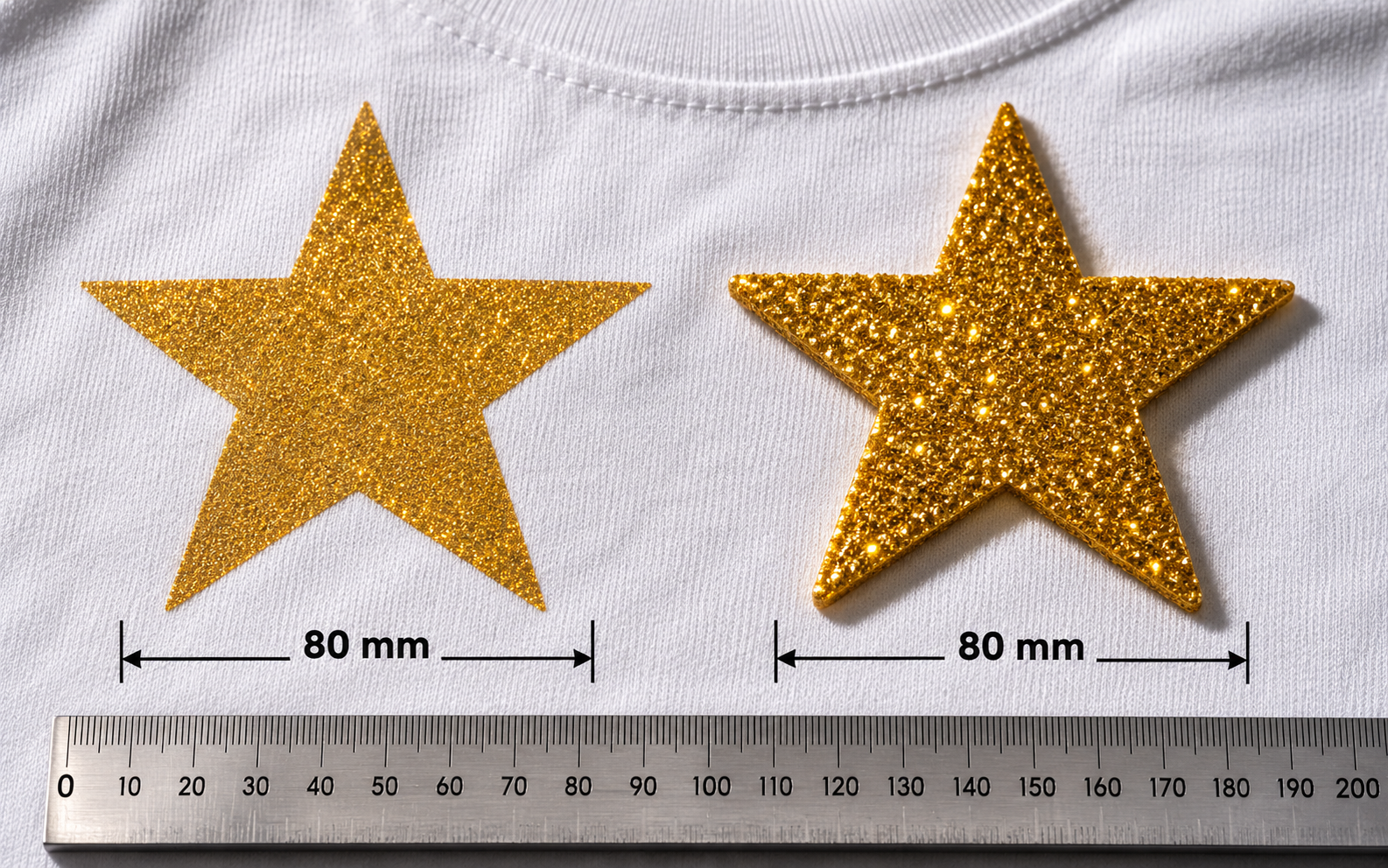
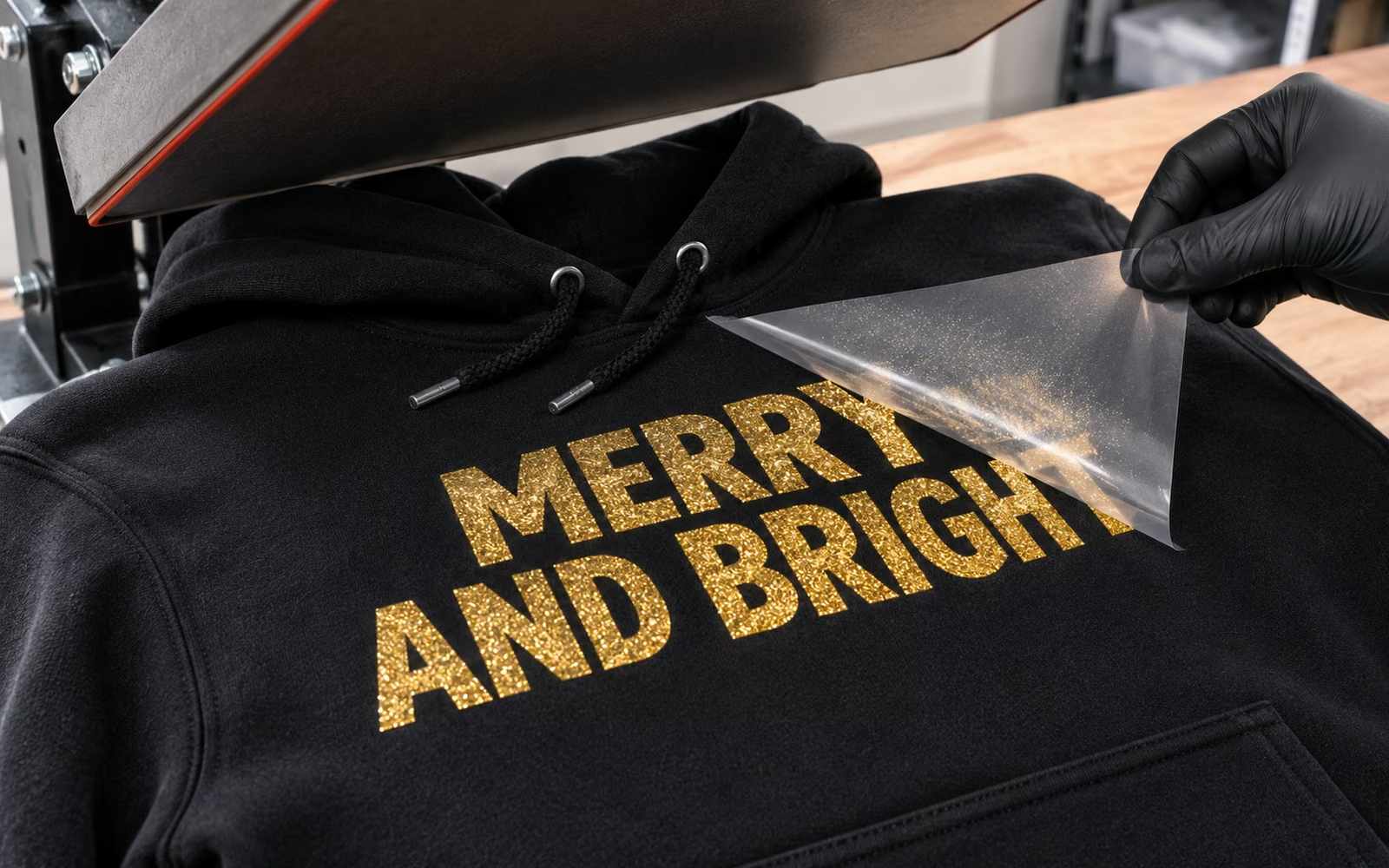
 Two different products are sold as glitter DTF transfers. One is an ordinary DTF transfer printed with a glitter-effect design: flat, soft and washed like any other print. The other is true glitter film, where your design is printed onto a film that carries real glitter particles, so the sparkle is part of the transfer and the press recipe changes. Below: how each is made, which garments take them, what to send as artwork, and how they wash.
Two things get called glitter DTF
Ask for a glitter DTF transfer and you can be sold either of two things. The seller does not always say which. The first is a glitter-effect print. The sparkle is drawn into the artwork (highlights, a gold texture, a gradient that reads as glitter from a metre away) and the design is printed onto ordinary clear PET film with CMYK and white ink, powdered with hot-melt adhesive and cured. Under your hand it is smooth. There are no particles in it. It presses with the standard recipe and washes like any DTF print. The second is true glitter DTF film. The carrier arrives from the maker with a layer of glitter particles already bonded to it, usually gold, silver or one holographic colour. The printer lays white and colour ink on top of that layer, the powder goes on, and after curing the glitter leaves the carrier with the ink and becomes part of the transfer. You feel it straight away: a thicker, stiffer patch with a fine grit to the surface, closer to a flake heat-transfer vinyl than to a print. Call the first a glitter-effect print and the second glitter film. Glitter film sits alongside the hot peel, cold peel, matt and gloss films described in our post on DTF film, powder and ink types, and it parts company with all of them at the press.How glitter film presses differently
Ordinary DTF has one recipe at Brandum: pre-press the garment at 150°C for 2 seconds to drive out moisture, press the transfer for 12 seconds, peel after 3 seconds, then re-press for 3 seconds under a protective sheet. Polyester is pressed at 135°C. Most failures we see come from skipping the pre-press or from lint on the garment, and the method is written up in our DTF heat press settings post and the how to apply DTF transfers walkthrough. A glitter-effect print follows that recipe to the second. Glitter film does not. The glitter layer and the adhesive behind it need more heat and more time to bond, and the film is nearly always cold peel, so the recipe comes from the film maker rather than from us. xTool, which builds DTF printers and sells a glitter film roll for them, prints the figures on its glitter film page (read November 2026): 170°C, 18 seconds, 100 kg of pressure, wait 20 to 30 seconds, then peel the cold carrier, and re-press the finished transfer two or three times at the same settings to reduce cracking in the wash. The same maker's standard film instructions, updated 8 October 2026, give 150 to 160°C, 5 to 10 seconds and a medium 90 kg pressure. One maker, one printer, and the glitter version wants 10 to 20 degrees more heat and about twice the dwell time. Other makers' glitter films carry other numbers, so press the sheet you bought at the figures on its own data sheet, and test on a scrap garment if it came without one. Under-pressed glitter lifts at the corners, like any under-pressed DTF: our 150°C for 12 seconds is too little for a film that asks for 170°C and 18 seconds.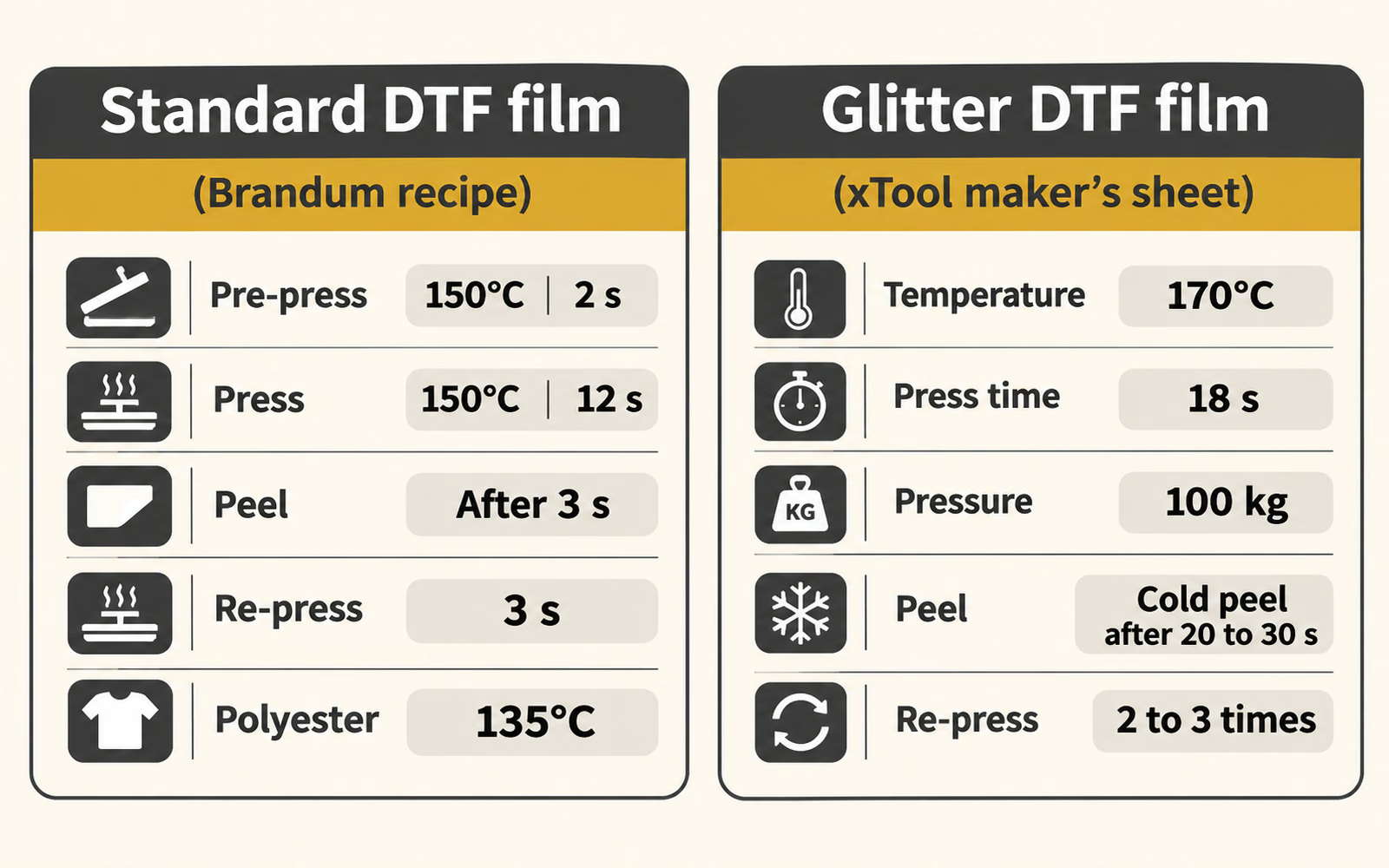
What artwork works on glitter film
Glitter particles are large next to an ink dot. A fine halftone, a 1 mm outline or a photograph loses its edges in the sparkle, and the white underbase sits on a glittering surface rather than a flat one, so colours lean towards the glitter's own tone: red on gold film comes out warmer, blue on silver film reads lighter. Lettering with strokes of 3 mm or more holds its shape; below that the thin parts break up and shed first. Bold shapes with solid fills work. One or two ink colours with the glitter doing the work is the sweet spot, and separate elements want 2 to 3 mm of clear space between them. Leave gradients, drop shadows, small text and anything built on a halftone for ordinary film. Leave registered brands and licensed characters off both: we do not print them on any film without the rights holder's written permission. Send a vector file (PDF, SVG or AI) or a PNG at 300 dpi with a transparent background, as set out in our best file formats for DTF printing post. Glitter film is a different sheet, so glitter designs cannot share a gang sheet with ordinary prints. They go on a sheet of their own.Which garments take glitter film, and which do not
Cotton and poly-cotton take glitter film well. They tolerate the heat and do not stretch much in wear, so the stiff film is not asked to move. A Gildan Heavy Cotton 5000 at 180 gsm, a Gildan Heavy Blend 18500 hoodie (50/50 cotton and polyester, 271 gsm) and a Just Hoods JH001 College Hoodie (80/20, 280 gsm) all give the glitter a dense, flat bed to sit on. Pre-press them as for any transfer: a damp hoodie is the quickest route to a cloudy, half-stuck patch. Polyester is a compromise. At Brandum, ordinary DTF goes onto polyester at 135°C, to stop the fabric dye migrating into the white underbase and to avoid shiny press marks on the knit. A glitter film that asks for 170°C for 18 seconds cuts straight across that. On a sublimated sports top it is likely to bring dye through and can leave a platen mark; xTool lists polyester as compatible with its glitter film but gives no reduced setting for it. If you want glitter on polyester, use the lowest temperature the film maker allows, a pressing pillow, and one test garment before the rest. The mechanics are in our post on DTF on polyester sportswear. Two refusals. Glitter film is not for sportswear or anything that stretches in wear: a leggings panel, a fitted base layer, a stretch dance costume. The film has far less give than a flat DTF print and cracks along the stretch lines. It is also not for tri-blends: xTool's own page says tri-blend fabrics are not recommended for its glitter film, and a soft, slippery tri-blend knit gives a heavy film little to hold.